El Nino update: 2006-07
Md. Rashed Chowdhury
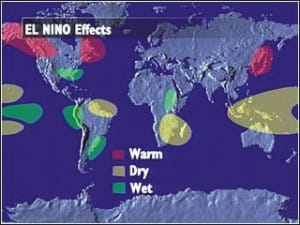
An El Niño has been developing in the equatorial Pacific since early summer and, based on conditions in the Indian Ocean, will likely grow in strength over the next two months. This forecasts is made on the basis of latest calculations of researchers at the University of Hawaii's climate centre, the International Pacific Research Centre (IPRC).El Niño, the recurring climate phenomenon with unusual warm ocean temperatures in the equatorial Pacific Ocean, causes abnormal weather conditions around the globe. While it has been the "poster boy" of climate variability over the past 20-30 years, scientists mostly ignored the Indian Ocean thinking it showed too little variation to excite any interest. This all changed in fall 1997 when scientists were stunned by rapid cooling of the normally warm Indian Ocean off Sumatra Island. This cooling of the eastern tropical Indian Ocean caught the curiosity of the climate community and drew many to study the Indian Ocean. They traced the unusual Indian Ocean cooling, dubbed Indian Ocean Dipole, to the big El Niño that was happening at the same time in the Pacific in 1997. In a recent study published last year in Journal of Climate, it has been investigated how such cooling in the eastern tropical Indian Ocean might impact El Niño and found that this unusual cooling weakens atmospheric convection over the region. This, in turn, sends atmospheric waves, called Kelvin waves, along the equator to the Pacific, and these waves cause anomalous westerly winds. It has been known for some time that such westerly wind anomalies are associated with a growing El Niño. In September, there was a report of an imminent cooling in the eastern Indian Ocean and, based on past 35 years of data, it has been found that when an El Niño was accompanied by an Indian Ocean cooling, there was a good chance that it would grow greatly in strength in the fall. For instance, the two super El Niños in 1982-83 and 1997-98 were both accompanied by unusual cooling in the eastern Indian Ocean. It has therefore been suggested by the researchers that it was these Indian Ocean conditions that powered the disturbances into the 'El Niños of the century.' Since 1997, there have been El Niño events in 2002 and 2004. Both were mediocre in strength, the researchers believe, because they didn't have the "push for growth from the Indian Ocean." El Niño prediction is being routinely carried out at weather agencies around the globe, but intensity forecasts are generally poor, which could be because many prediction models did not include the Indian Ocean. In fact, both the 1982 and 1997 super El Niños caught scientists by surprise as they were unfolding. El Niño brings about abnormal weather conditions around the globe, including flooding in Ecuador and Peru, and drought in Bangladesh. For example, the 1997 drought in Bangladesh was particularly severe as the region was hit by both a mega El Niño and cooling in the eastern tropical Indian Ocean. Dr. Md. Rashed Chowdhury is Research Scientist and a Graduate Faculty at the Pacific ENSO Applications Center in the University of Hawaii, USA ([email protected])
|
|

