Around The Globe
Colourful 'Day of the Dead' festival in Mexico
The Day of the Dead (Día de los Muertos, Día de los Difuntos or Día de Muertos in Spanish) is an ancient Aztec celebration of the memory of deceased ancestors that is celebrated on November 1 (All Saints' Day) and November 2 (All Souls' Day).The holiday is especially popular in Mexico where it is a national holiday, and is celebrated in the Philippines, in Mexican-American communities in the United States, and to a lesser extent, in other Latin American countries. It is a public holiday in Brazil, where many Brazilians celebrate it by visiting cemeteries and churches, bringing flowers, lighting candles and praying. Though the subject matter may be considered morbid by many cultures, Mexicans celebrate the Day of the Dead joyfully, and though it occurs at the same time as Halloween, All Saints' Day and All Souls Day, the traditional mood is much brighter with emphasis on celebrating and honouring the lives of the deceased, and celebrating the continuation of life; the belief is not that death is the end, but rather the beginning of a new stage in life. The origins of the Day of the Dead celebrations in Mexico can be traced back to the indigenous peoples of the area, such as the Aztec, Maya, P'urhépecha, Nahua, and Totonac. Rituals celebrating the lives of ancestors have been observed by these civilisations for at least the last 3000 years. Plans for the festival are made throughout the year, including gathering the goods to be offered to the dead. During the period of October 31 and November 2, families usually clean and decorate the graves. Most visit the cemeteries where their loved ones are buried and decorate their graves with ofrendas, or offerings, which often include orange marigold called Flor de Muerto, Spanish for 'flower of the dead' which are thought to attract souls of the dead to the offerings. Toys are brought for dead children (los angelitos, or little angels), and bottles of tequila, mezcal, pulque or atole for adults. Families will also offer trinkets or the deceased's favourite candies on the grave. Ofrendas are also put in homes, usually with foods such as candied pumpkin and pan de muerto or sugar skulls. Some people believe the spirits of the dead eat the "spiritual essence" of the ofrenda food. The pillows and blankets are left out so that the deceased can rest after their long journey. In some parts of Mexico, such as the towns of Mixquic, Pátzcuaro and Janitzio, people spend all night beside the graves of their relatives. A common symbol of the holiday is the skull (colloquially called calavera), which celebrants represent in masks, called calacas (colloquial term for 'skeleton'), and foods such as Candy Skulls, which are inscribed with the name of the recipient on the forehead. Other holiday foods include pan de muerto (or 'bread of the dead'), a sweet egg bread made in various shapes, from plain rounds to skulls and rabbits often decorated with white frosting to look like twisted bones. There is also dancing with colourful costumes, often with skull-shaped masks and devil masks in plazas or gardens in different towns. In some parts of the country, children in costumes roam the streets, asking passersby for a calaverita, a small gift of money; they don't knock on people's doors. Compiled by Cultural Correspondent
|
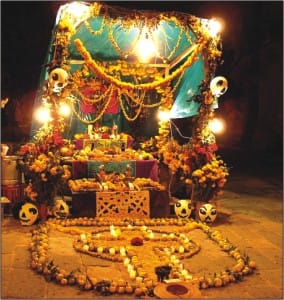
A decorated alter to celebrate 'Día de los Muertos' |

