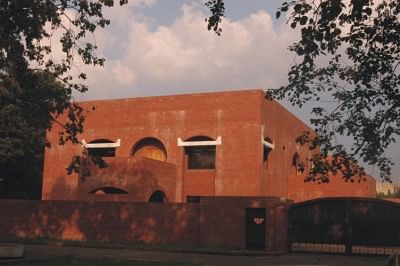
Speakers' Residences
A legacy of defiance
Kausar Islam Ayon
The two houses built within the parliament complex as official residences for the Speaker and his deputy that sparked controversy have been unused for more than a year, as both officials declined from residing here to avoid legal complications. Although the past Bangladesh Nationalist Party (BNP) led four-party Alliance government defiantly went ahead with the construction ignoring protests and requests by different national and international organisations and a number of eminent personalities. The Public Works Department (PWD) completed the construction including interior designing by July-August last year. But these houses were not used for even a single day, as neither party was interested in residing here. Parliament officials said the PWD has employed two cleaners to regularly clean the houses. "Sometimes a team from PWD comes to inspect the overall situation. Apart from that the buildings have no other use," said an official. It is known that the government was bent on convincing the speaker and the deputy to reside in these houses at least for the last few days of its tenure, but the allottees refused. With the 8th parliament completing its tenure on October 27, there is no possibility that these houses would be occupied for the next four to five months. Speaker Jamiruddin Sirkar told the media that he had not wanted to reside in a house having legal complications. Sources said that the speaker had sent a letter to the Attorney General (AG) in April this year asking if there were any legal barriers in case he wanted to reside in that house, but is yet to receive a reply. When checked, AG Mohammad Ali said that it was an old matter and the files had to be checked. Official homes for the Speaker and Deputy Speaker were built defying Louis I Kahn's original design, where Kahn had earmarked the site as an open space. The government constructed these buildings on five acres of land at a cost of around Tk 6 crore. Besides the public, architects and environmentalists protested the move of having these buildings inside the complex defying Kahn's design since the beginning of the construction. On 14 May 2003, Bangladesh Paribesh Andolon (BAPA) and Institute of Architects Bangladesh (IAB) jointly filed a writ to the High Court. Bapa and IAB in their petition said the construction of the two residential buildings on the parliament complex would greatly distort the Sangsad Bhaban's final masterplan by world famous architect Louis I Kahn. Considered worldwide as one of the finest examples of modern day architecture, Sangsad Bhaban complex has been subjected to repeated infringement on its designs by successive governments. The Awami League government built the NAM conference hall demolishing the Weather Building originally designed by Kahn. The ruling coalition distorted Kahn's design by taking up a massive project to build a bridge across the Crescent Lake behind the main parliament building and converted a large area of Chandrima Udyan into a mausoleum of the late president Ziaur Rahman. The complex consists of a mosque, a seminar hall and other installation. Experts say such massive distortions of the original plan would not only destroy the beauty of Sangsad Bhaban but also hinder the international process of declaring the parliament complex a World Heritage Site. Conservationists of Kahn's work said that their battle against such an illogical move is not over yet. They will continue their movement until the authority will have no choice but to demolish these structures and save the heritage thereby. "The complex, although completed does not mean it is legitimate and we will continue our protest until they are demolished. We also demand punishment of the people involved," said Saif-ul-Haque, an architect involved in the protest against the construction of Speaker and Deputy Speaker's official residences. The chronology of events centred on construction in the parliament complex is as follows. - The PWD started construction inside the parliament Bhaban on October 26, 2002. Following strong protest continued media coverage, construction work temporarily stopped on October 31.
- In December 2002, the construction work resumes amid protests and letters in newspapers. The protest by general people, architects, artists, and environmentalists went on.
- On March 3, 2003, President, Institute of Architects, Bangladesh sent a letter to the Prime Minister urging her intervention to stop the work.
- On May 14, 2003, writ to the High Court jointly by Bangladesh Paribesh Andolon (BAPA) and Institute of Architects, Bangladesh (IAB).
- On May 18, 2003, court once again issued a stay order on the construction.
- On 28 august 2003 Chamber judge vacates stay order.
- On May 19, 2003, High Court gave a ruling to stay construction work at site.
- On August 18, 2003, Appellate Division stays High Court ruling allowing construction to continue for three months.
- On June 21, 2004, High Court declared the construction of the Speaker and Deputy Speaker's residences illegal. The bench also directed the government to take necessary steps to declare the parliament complex a national heritage.
- On July 7, 2004, Appellate Division declined to pass a stay order on the June 21 High Court verdict and also brushed aside the government plea to put an embargo on media coverage on any development work at the parliament complex.
Meanwhile PWD completed the 60 percent of the work on these two buildings while the legal battle continued. The construction was completed in 2005.
|