Conscience & Society
The Pope's jihad
Muslehuddin Ahmad
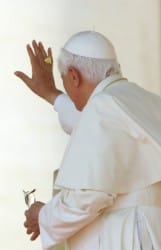
The recent comments of Pope Benedict XVI, the head of the Catholic Church, about jihad or holy war and the way Prophet Mohammad (sm) preached Islam created uproar around the Muslim world. The Vatican explained the situation three times with some form of apology, but that did not fully satisfy the Muslim world. This led the pontiff to address the Muslim envoys attached to the Vatican with a view to explaining his intention. This has largely worked, but some still question why Pope Benedict at all made such a reference. In Newsweek (Sept. 25) Jon Meacham puts it this way: "By quoting a 14th century Christian emperor on an 'evil and inhuman' Islam, Benedict XVI ignited a global storm." What was he thinking? Meacham explains: "Roughly put, his argument was this: to Benedict, Islam's conception of God so stresses God's will that God can be understood to command the irrational." Here two points are to be noted: God's will cannot be stressed that may force Him to command the irrational. To err is human, God is not a human being that He can make mistakes. Such a view about God may put one's faith under question. God is unseen, self-sustaining, and omnipotent; He does not depend on anybody's will to run His creation and does not order anything that is not rational. This is the basis of faith whether one calls oneself Jew, Christian, or Muslim. To Benedict XVI, "irrational violence is displeasing to God." He is right and there is absolutely no doubt that any irrational thing is displeasing to God. However, if there is "irrational violence," then there must be rational violence and one has to see whether the violence occurring today is rational or not, and look for the reasons and background of such violence. My sense is that present day violence in Afghanistan and Iraq can be categorized as rational violence as a result of irrational unilateral violence (attacks) by the other party(s) in the conflict. All the violence that has been taking place today has very little to do with Islam. One has to go through history to find out the causes. Start with the Christian Crusades. Jon Meacham continues to argue that: "By speaking of Jihad without alluding to Christianity's dark history of violence in the name of God -- the Crusades, forced conversions, pogroms, the inquisition -- Benedict seemed to be denouncing Islam while failing to acknowledge that any religion, including his own, can be manipulated and perverted to evil ends." Harvard Divinity School Dean Willium A Graham said: "It is hard to construe the pope's remark in a benign way. Historically, there is no more basis for arguing the same about Christianity or Judaism....there are people in all three who have landed outside the rational. Islam has bloody borders right now, but Christianity has certainly been bloody, as has Judaism in its more extreme forms." Graham also argues that: "Islam has spread far more thoroughly by proselytizing than by the sword." I would argue that Islam did not proselytize i.e. it persuaded others to accept Islam. The pope himself quoted from the holy Qur'an that "there is no compulsion in religion." So whoever preached Islam, I suppose he did it as Islam says -- practice Islam and show the goodness therein and that should attract people to Islam. This is what Prophet Mohammad did. Therefore, it was absolutely wrong to say that Prophet Mohammad preached Islam through the power of the sword. It used to be just the opposite. The prophet practiced Islam in a manner that attracted people to be believers i.e. Muslims. Prophet Mohammad and his associates fought only those who declared open war against the prophet's messages that he received from God as His messenger. Indeed, Prophet Mohammad had extremely good relations with the people of other religions who lived in peace and harmony with the Muslims. He indeed, had special ties with the Christian king of Abyssinia (present Ethiopia) and once he sent some of his followers who were under attack from the non-believers to Abyssinia and they received the protection of the Christian king who was very kind to the Muslims. This also showed the greatness of the Christian king. The Abyssinian Christian king would not have extended his hand of support to Prophet Mohammad if the prophet had ever acted against Christians. One would have thought that instead of quoting a revengeful and offensive statement of a 14th century emperor whose relation with the Muslim Ottoman empire was bad, whose words the pontiff said "do not in any way reflect his personal thought on the matter," he could have taken steps to clear up any misunderstanding already existing between religions. We are told that the pontiff was even eager to call for an inter-faith dialogue which hopefully would be pursued by the Vatican administration. Indeed, his predecessor pontiff, even at his old age worked for religious harmony and even once visited a mosque in Damascus and prayed there for world peace. Pope Benedict XVI is already seen as one of the conservatives in his approach to other religions. One would expect him to follow his predecessor pontiff and go for more flexible approach as there are already some politicians of the west who can be called extremists in their political thoughts and ideologies, indeed irrational ones, which have been responsible for the present violence in some sensitive parts of the world. But as the pope is not a politician, he could really move ahead rapidly for forging good relation between the people of faith and there he will receive full support from all peace loving people of the world. Inter-faith platform
The New York Times, however, said in its editorial after the pontiff's speech that: "The world listens carefully to the words of any pope. And it is tragic and dangerous when one sows pain, either deliberately or carelessly. He needs to offer a deep and persuasive apology, demonstrating that words can heal." The Times editorial was really helpful and deserves appreciation. The Times board may consider building a platform for inter-faith dialogue, if possible with President Carter or President Clinton, whoever is available to spare some time, as its head. CNN and BBC also could be helpful as these organizations appear interested in such an inter-faith issue. Incidentally, in this connection, I may mention that some years back I had the privilege of raising very briefly this issue of inter-faith dialogue with HRH Price Charles when I met him in Dhaka. I found him quite sympathetic to the idea. So under the present disturbed situation that emerged from unilateral actions of some top political leaders of the west and particularly America, it would be necessary to pursue this issue of inter-faith dialogue with some seriousness and the lead should come from religious and social thinkers. I am sure, many others like us, would be prepared to lend full support to such an effort. Jihad
Jihad, as far as my knowledge goes and I remain open to suggestions, has strict meaning and applications. One may declare jihad against anyone, any group, society, or even a nation if any of them "wage war against God." It is very difficult to precisely define this term. So, one has to be extremely careful before declaring jihad against anything. There must not be any presumption or assumption in such a sensitive issue as one's wrong jihad may create serious problems for others in the society. The other reason for jihad could be if any one or any group or any community of people is thrown out of their legal homes, he/they may declare jihad and fight back till his/their homes are recovered. The Qur'an (Sura Baqaara, 191) says: "Turn them out from where they have turned you out." Here comes the issue of rational violence. The Palestinians and other concerned Arabs are known to have been waging such a jihad against Israel's occupation of Arab land. The Palestinians and the Arabs are not fighting Judaism, they are fighting against Israel's occupation. There are however, serious excesses, the "irrational violence" on both sides, which must be condemned. There may be many other reasons, but the one that is very important and mentioned in the holy Qur'an (Sura Baqaara 191-193): "For tumult and oppression are worse than slaughter,... Fight them on until there is no more tumult or oppression, and there prevails justice and faith in Allah; but if they cease, let there be no more hostility." This also applies to the Palestinians as there has been systematic tumult and oppressions by Israel against the Palestinians, which led to violence from Palestinian side to liberate themselves from Israeli yolk. While conducting jihad, the Jihadies must also observe the strict Qur'anic principles which are humanitarian principles too that "women, children, and the infirm must not be harmed; trees and crops not to be cut down nor peace be withheld when enemy comes to terms." Jihadies often go beyond what is authorized taking the plea that "we can kill their children as they (enemies) also kill our children." Islam never allows harming of children, women, and the infirm. Any retaliatory or revenge action by any, because of somebody else's crimes, against innocent women, children and the infirm, for which they should held responsible to God, is un- Islamic. Allah's orders are very strict -- "fight those who fight you." This means you fight only when you are attacked and not you start the fight. Moreover, the children are obviously not fighting anyone; so, they cannot be made targets. There is absolutely no room for excesses as "Allah loveth not those who transgress limits" (ref. Qur'an) and indeed no amount of fatwa can authorize anyone to kill innocents. Muslehuddin Ahmad is a former Secretary and Ambassador and founder VC of North South University. He is also the Chairman of Civic Watch, Bangladesh.
|