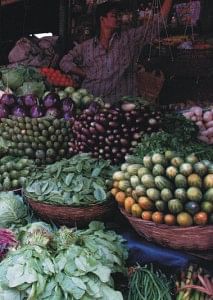
Vegetables turn harmful by toxic wastes
Most vegetables sold in city markets contain toxic residues, says experts
City Correspondent
Most vegetables coming into the city from peripheral areas contains toxic residues harmful to humans, according to Dr Jasiumuddin Ahmad, environmentalist and Professor of Jahanghirnagar University.This was revealed at a seminar organised by Save the Environment Movement titled "Mismanagement of Industrial Waste: its effect on humans and environment" in the city last week. Research was conducted by him and his student Abdul Gani on eight lethal metals that were found in different vegetables picked from industrial areas like DEPZ, bank town and Hamayetpur in Savar. Metals like lead, copper; zinc, chromium, cadmium, arsenic, nickel and iron were measured in the different sources like water, arable soil and in the different parts roots, stems, leaves and edible areas of crops and vegetables plants. "I tested the samples at the Bangladesh Atomic Energy Commission in Savar, and to re-confirm the result of the samples I tested them again at the College of Leather and Technology in Hazaribagh. The result was the same," said Abdul Gani, lecturer of Dhaka University of Engineering and Technology of Gazipur under the supervision of Dr Jasimuddin. "One will find large quantities of colourful water emerging from several industries on the way to Aricha from Savar. This water pollutes the environment in many ways," said Jasimuddin. "The plants and vegetables that grow in this soil also harm humans and by consuming these vegetables we are unknowingly affected by the process," he added. Most of the plants that possessed very high amounts of metals much higher than World Health Organisation's (WHO) permissible limit said Jasimuddin. Long term consumption of these contaminated crops and vegetables can cause different diseases in the human body," he further said. The rate of cadmium of 12.34 pp (milligram per kilogram) is high in red spinach and low at 1.05 ppm in Luffa Gourd. According to WHO per measurable level for cadmium is 0.5 to 1.00 ppm. This high amount of Cadmium could be responsible for kidney and lung diseases, hypertension and cancer. Nickel was found as high as 120.26 ppm in sweet potato and according to WHO 3-25 ppm is the tolerable rate. This high amount of nickel may cause headaches, nausea, weakness, dizziness, muscle pain, fatigue, and lung damage. According to WHO the tolerable level of arsenic is 0.01- 1.00 ppm but in these areas arsenic is found high as 0.74 ppm in radish which may cause central necrosis, cirrhosis, damage in bone marrow and skin cancer. While the tolerable amount of chromium is 0.5- 5.00 ppm according to WHO chromium is found high 19.75 ppm in radish in these areas, which may cause ulceration of skin and irritation. Lead is found high 62.45 ppm in red spinach and according to WHO 10-20 ppm is tolerable. This high amount of lead may cause disruption of haemoglobin, synthesis, brain damage, damage to nervous system and kidneys. Jasimuddin found zinc at 73.04 ppm in bottle gourd and WHO's permissible level is 10-100 ppm, which may cause vomiting, headache, lethargy, depression and dizziness. According to WHO the tolerable level of iron in human body is 70-300 ppm but in these areas iron is found as high as 1354.21ppm in radish that may work as combined action in developing cancer in human body. During the research Jasimuddin also found copper at 24.82 ppm in luffa gourd as and WHO's permissible level is 2-10 ppm, which could give rise to thalassemia, damage in brain tissue. Speakers at the seminar gave emphasis on creating separate zone like Export Processing Zone for those industries which discharge toxic wastes. "As the industries are coming up haphazardly, they severely pollute the area in different ways, thus a separate zone only for industries producing toxic waste as a by-product is needed. Public awareness in this regard is essential to reduce the problem," said AQM Mahbub, professor and chairman, department of Geography and Environment, Dhaka University. "Other than awareness the authorities should be pressurised to take action against these haphazardly situated industries," he added. Jasimuddin in his research has also tried to give a solution regarding the industrial effluent. "Like many developed countries before discharging industrial effluents, they should be converted to substances that cause no harm, not create any problems, polluted water, soil or food," Jasimuddin added.
|