By The Numbers
The power puzzle
ANM Nurul Haque
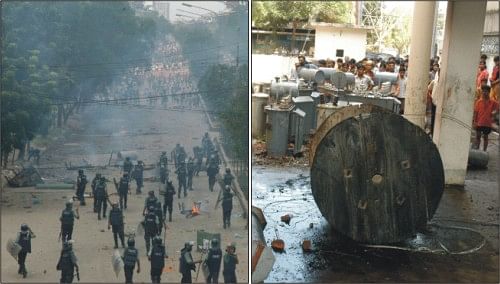
A spectre of a greater power crisis looms large as 19 out of 61 power generation units went out of order and the nation experienced load shedding that hovered around 2,200 megawatts (mw) on September 18, the highest power shortage in the country ever. According to the Power Development Board (PDB), as many as 19 units remained shut down, either for serious technical glitches or for maintenance reasons, slashing the electricity generating capacity by 867 mw. The whole country has been reeling in a perennial power crisis with a daily power supply shortfall of around 1,100 mw on an average for months now. The people are now experiencing frequent power outages that in some places last for twelve hours a day. Frequent power disruptions have been a constant source of misery for the people while they expected uninterrupted power supply to avoid further ordeal during their fasting. The situation is even grimmer in the rural areas where the consumers hardly get a few hours of electric supply a day. The protests against power outage are now turning more violent. Recurring power failures have long crossed the people's tolerance level and their frustration is now giving way to anger. They took to the street and fought pitched battles with the police in many parts of the city. Police opened fire on the power-hungry people, attacking a number of power stations, injuring 200 people. The present severity of power outage may be leading the way to an anarchic situation across the country. The high-sounding promises of the BNP-led government on power sector appear to be mere political gimmick as the government has been able to add only a meager 80 mw of electricity during its tenure. It failed to install any new power projects in the last five years except the 80 mw Tongi power plant which remains shut down most of the times due to its sub-standard quality. In view of the vulnerable situation, the government at the last moment has approved different power distribution projects worth Tk 2,745 crores, but none of the projects are even related to power generation. The government at last has decided to suspend electricity supply to big shopping malls and less important small industries during peak hours in the evening to and cut power supply to billboards. Rationing of electricity and proper management of load dispatch centre can help to overcome the crisis to some extent. The lack of coordination among the officials of Power Division, PDB, Power Grid Co, DESA, and DESCO has aggravated the power outage situation. Many important cities in the world, including Paris and Amsterdam, have electricity rationing where all shopping malls excluding the bars and restaurants remain closed after evening. All shops in New Delhi remain closed at seven in the evening. Why don't we follow this practice? If the big shopping malls in the city are closed at dusk, it would help to save about 75 mw of power which could be diverted to other needy areas. Surely the economy will not be badly hurt if the shopping centres in the city are closed down after the evening. It may affect the sale for a few days, but eventually people would adjust and finish their shopping during the day. They would be happy to have a few more hours of electricity at home rather than in the extravagantly-lit shopping malls. The shop owners' association has rejected the government's decision to suspend power supply to the big shopping malls. The government has no other alternative but to drastically reduce power consumption in the less important sectors of the economy to overcome the crisis. There has been a huge allocation in the national budget for the power sector every year since the beginning of the BNP-led four-party rule, but only 80 mw of new power was generated. The government allocated some Tk 16,409 crores for development of the power sector. The allocations were Tk 2,358 crores in 2002-03, Tk 4,067 crores in 2003-04, Tk 3,308 crores in 2004-05, and Tk 3,270 crores in 2005-06. The allocation in the current fiscal is Tk 3,405.86 crores. Bangladesh spent $1,784,485,892 (equivalent to Tk 12,000 crores) for expatriate experts in power sector in the last 15 years. This is quite a puzzle. This amount was spent on 148 foreign experts in six state-run power plants, excluding the expenses for their accommodation, cars, medical facilities, airfares, and insurance. This amount, spent in the name of technology transformation, was quite enough for setting up at least five 1000 mw capacity power plants in the country. According to a UNB report, the power generation went down to 3,000 mw against the countrywide demand of about 5,000 mw, accounting for a shortfall of 2,000 mw. Currently the country has about 8.5 million power connections covering nearly fifty million people. The number of connections was five million five years ago. The country generated 3,100 mw power in 2002 and stayed even with a demand of 3,100 mw. Now in 2006, the country generates only 3,300 mw power while the number of connections has almost doubled. There is a puzzle here as well. Increasing number of power connections has brought huge fortune for the ruling party men who were involved in supply and installation of poles. On the other hand, it helped the local MPs to claim cheap applause for bringing power to their areas. The long-standing and stubborn problems in the power sector, which are without any remedy, are another puzzle. This is not really a political issue but a systemic failure of the government to deal squarely with its power sector. Bangladesh is a country that is hungry for more energy but has failed to develop and deliver the necessary power. The 15 years of its democracy saw so many unrealistic programs for energy development but little has come out of them. These power puzzles must now be solved with utmost sincerity and determined efforts. Otherwise the country will never be able to get our to the power crisis. Whatever the acclaimed successes of the government may be, all the successes have been eclipsed by serious failures in three major areas -- improving power supply, curbing massive corruption and unbridled price hike. It is a particular malady for the nation that the government instead of facing the facts, is repeatedly denying the truth. The anguished people find their denial to be a cruel prank. The acute power shortage is not a consequence of the tempo of development as claimed by the prime minister, but an outcome of the total failure of the government to keep the chaotic situation under check and curb corruption in the sector. The recent power crisis has not befallen the nation all of a sudden, but is the natural consequence of years of negligence. The efforts of this government to increase power generation capacity have been quiet negligible although Tk 16,409 crores were spent in the last five years. The present power crisis has exposed the avarice and weakness of the government. Such a situation is bound to happen when lack of competence is complemented by greed for money. ANM Nurul Haque is a columnist of The Daily Star.
|