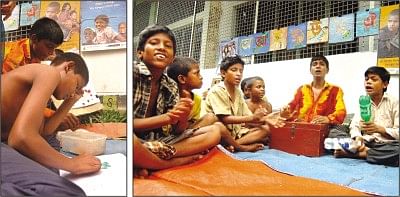
Open air schools for street children
Imrul Hasan
Nine year old Moushumi, a street child living in Railway Colony, Kamalapur never fails to attend her school. "I do not feel well if I do not come to school. I never want to miss the opportunity to play with my fellow students and draw pictures of different things," said Moushumi. Moushumi is a student of a special school arranged for them by a non-governmental organisation behind the Dhaka University Central Library premises. Ali Akbar, a 10-year old boy who collect rubbish with other street children near National Stadium said: "After working the whole morning, I get a chance of recreation here and at the same time I can interact with my friends, which gives me enormous pleasure and excitement." Akbar, whose parents live in Patuakhali, attends a similar school in Osmani Uddyan. To develop the physical and mental condition of street children, Aparajeyo Bangladesh (AB) and Appropriate Resources for Improving Street Children's Environment (ARISE) have been running 16 open air schools in total for these children in the city. The project by AB, a non-governmental organisation began in 1996 is being funded by Manusher Janya at present, while ARISE, a project of Department of Social Services under the Ministry of Social Services aided by United Nation Development Programme, started their project in 1998. Some of the spots where these schools operate are Gabtoli bus terminal, High Court premises, Kamalapur train station, Sadarghat launch terminal, Dhanmondi park, behind Dhaka University Central Library, near Sayedabad bus terminal, the field adjacent to Bangabandhu National Stadium, Osmani Udyan etc. The street children aged between 7 and 18 years, living in railway station, launch and bus terminals, busy markets and parks are provided free education for their mental growth, but without hampering their working hours. In the schools, stories are read to these children. They also draw pictures, play with their friends, sing songs and basically learn through having fun. Dilara Jaman, a teacher of ARISE, teaches at Osmani Uddyan. She said: "Most of the boys in the open air schools are very fond of mathematics, as they manage their daily accounts. However, girls like to write poems." Md. Farad Sarkar, also a teacher of ARISE, said while teaching some children behind Dhaka University Central Library: "We also arrange excursions like picnic or a tour to a famous place. They eagerly wait for these excursions throughout the year." Officials at AB said that the spots for the schools have been acquired free of cost from the community or relevant authorities. Besides, the schools run for only two hours a day, 6 days a week and the timing is arranged in such a way so that their working hours are not hampered. "Before classes begin, staff walk around the neighbouring area to identify newly arrived children and ask them to attend classes," said Monowar Hossain, an official of AB adding that the regular students also inform their staff of new arrivals in the areas. "These schools are the initial point of contact. When the teachers make contact with a child, the most important task is to build a trusting relationship," he added.
|