Saarc to make South Asia poverty-free region
Speakers tell Japan-Saarc cooperation confce
Staff Correspondent
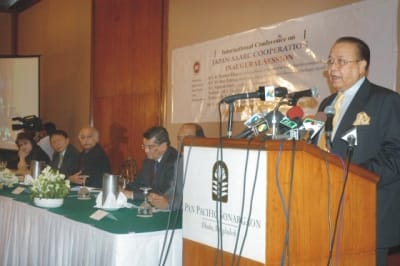
Both Bangladesh and Japan yesterday expressed their overwhelming hope that Saarc can play a catalytic role in making South Asia a poverty-free region and contribute to the development of whole Asia through regional cooperation.While Japanese Prime Minister Junichiro Koizumi termed the development of South Asia as 'indispensable' for the prosperity of Asia in its entirety, Foreign Minister M Morshed Khan said functioning of Saarc Development Fund could pave the way for a much broader engagement between the Saarc and the observers in future. The views were expressed at an international conference on Japan-Saarc Cooperation organised by Japan Study Centre (JSC) of Dhaka University at a city hotel. The Japanese prime minister, in a message read out by Yonezo Fukuda, charge d' affairs of Japanese Embassy in Dhaka, at the conference, said, "I think the activities of Saarc in last 20 years for the welfare and quality of life in South Asia are truly valuable." It is with such recognition, Tokyo has supported Saarc through 'Japan-Saarc Special Fund,' he said, adding that his country remains committed to promoting further cooperation with Saarc and its member states. Speaking as chief guest M Morshed Khan said Saarc-Japan Special Fund is the only fund of its kind in supporting the key areas including social development, gender mainstreaming and natural disaster management. "I believe once the guidelines on observer status in Saarc are finalised, we look forward to Japan being engaged more vigorously in different areas of cooperation," he noted. "When we say that the 21st Century belongs to Asia, it won't be an overstatement to say that the thrust would come from South Asia and South-East Asia," Morshed said. South Asia collectively offers as much as around 440 million growing middle class with dispensable income, which will grow fast with the expansion of these economies, he said, adding, "We are looking at an economy of about $800 billion." Saarc has taken a more focussed and result-oriented course, he said, adding that Safta has come into force and "We are considering the inclusion of Trade in Services in Safta. There has also been significant progress in the key areas like counter-terrorism, environment, tourism, energy and connectivity." Yonezo Fukuda said pooling its enormous natural resources for an integrated approach to economic development could do wonders and free the Saarc region from the curse of poverty and hunger. Japan is keen to share her experiences and expertise in capacity building, training and technical cooperation with Saarc to develop it into a strong and vibrant regional bloc, he noted. Kunio Senga, director general of South Asia Department of Asian Development Bank, said strong political commitment is a must for the success of regional cooperation in South Asia. Foreign Affairs Advisor Reaz Rahman said Saarc failed to make desired progress due to political differences. Prof Ataur Rahman, director of JSC, delivered the welcome speech while DU Vice-chancellor Prof SMA Faiz chaired the session. Dr Takako Hirose of University of Senshu, Japan, Shinsuke Shimizu, director of Southwest Asian Division, Ministry of Foreign Affairs of Japan, Ikuro Sato of Japan Bank for International Cooperation, Shuji Uchikawa of the Institute of Developing Economies, Japan and Koji Suzuki, executive director of Asian Disaster Reduction Centre, spoke at the working sessions.
|