Children's Development Bank
An innovative way to help street urchins
Imrul Hasan
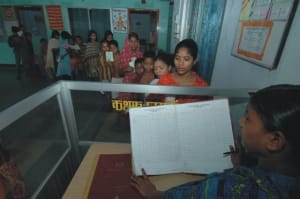
Usually street urchins and working children of the city spend their money on food, clothes, drugs and entertainment. It is because they do not have facilities for saving the money. Some of them try to save money, but others take it away forcefully.Twelve-year-old Alam worked in a tannery at Lalbagh till November 2005. He kept all his money with his employer. "But I was cheated. When I wanted to take back the money, he (employer) didn't give it to me," said Alam. "After that I felt that it was better to spend the money at the end of the day rather than it being taken away by somebody. From that feeling I kept my little amount as savings with the Children's Development Bank (CDB)," Alam added. Like Alam, a large number of street and working children who were either cheated or exploited now keep their little amount at CDB. Most of them are 8-16 years old. In September 2004, Aparajeyo Bangladesh (AB), a voluntary organisation, launched a scheme for collecting deposits from the street children. The name of the scheme is Children's Development Bank, but it does not carry out commercial banking. CDB has 10 branches in AB's shelter based programme for street and working children. The bank provides the children with a safe place to keep their money and encourages them in savings for their future and sensible use of their money. Mariam, 14, lived on the streets of Dhaka until she enroled at the Drop in Centre (DIC) of AB in August 2003. She had run away from home in Narsingdi after being abused. "I attended classes and completed training in tailoring and embroidery at DIC. I'm now working in a garment factory as a helper and earn Tk 1,100 a month," said Mariam who saved Tk 20,500 in the CDB. Now she wants to start poultry business. Fifteen-year-old Sumi, now the manager of CDB branch at East Tejturibazar, ran away from her home as her parents got separated and father had a second marriage. She used to beg on the streets in Dhaka. "I became addicted to drugs and also fell sick. In April 2001, I enroled at AB's Drop in Centre where I received treatment. I studied there and also completed beautician training," said Sumi. Sumi was made the manager of the CDB branch at East Tejturibazar in 2004. She maintains all the ledgers and accounts of the bank. "I encourage children to open accounts in the bank and save their money for positive use in the future. I enjoy my work and feel very proud of my development," said Sumi. According to CDB officials, the bank provides savings and credit facilities to street and working children who themselves are responsible for the running the bank. Besides, the children who attend this shelter-based programme select a development manager and assistant development manager. There is a management committee, a loan committee and a general body representing the children in each bank. "These bodies are elected by the children from their respective centres. Each of committees has their own terms of reference that was developed by the children," said Mahbub Islam, the project manager of the DIC at East Tejturibazar. The children have drafted the constitution of the CDB. "It covers criteria for membership, eligibility and size of loans, interest paid on savings and charged on loans, repayment terms and guarantees and so on," Mahbub added. In the 10 branches of CDB in Dhaka have 1,400 members now. The total amount of deposited money is Tk 9.67 lakh in current accounts and long-term savings accounts. A total of 845 children have current accounts. The minimum amount saved is Tk 10 and the maximum is Tk 600. The total money saved is Tk 1,09,572. In the long-term savings, 481 children have accounts. The total money saved is Tk 8,57,204. The lowest amount saved is Tk 10 and the highest is Tk 36,200.
|