TechNews
Samsung laptops replace HDDs with flash memory
StarTech Desk
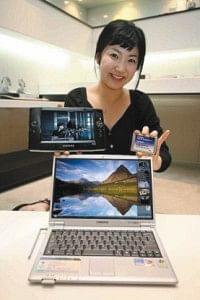
A new chapter in the story of computing has been written. Samsung announced the world's first commercial PCs sporting NAND flash memory instead of traditional hard drives.The Q1-SSD, an Ultra Mobile PC, and the Q30-SSD, a laptop PC with a 12.1-inch screen, both feature 32-GB flash-based solid state disks (SSDs). The flash memory drive can read data three times faster than conventional hard disks (53MB/s) and write data 150 percent quicker (28MB/s). Best of all, with no disks to spin up, there's better protection against shock, 25-50 per cent faster boot-up/sleep recovery times, longer battery life and no noise from whirring fans. The Q30-SSD looks set to come with a mighty sting of around $3,700 US-equiv when it hits the shelves in Korea (only) from early June onward. "The SSD laptops are targeting a different consumer group from conventional laptop users,'' explained a Samsung spokesperson."And the price will go down gradually.'' The SSD is a bit lighter than a normal drive and can boot Windows XP about 25 percent to 50 percent more quickly than normal drives. In addition, because they do not spin, the SSDs run completely silently. Some industry observers are impressed with the technical accomplishment, but not with the price tag. "It's an exciting technological advance," said Nicole d'Onofrio, an analyst at technology research firm Current Analysis. "But, due to the cost and limited memory capacity, it's only going to appeal to a limited market. About 30 percent of the laptops sold in the U.S. had a hard drive of 100 gigs or more." She predicted that SSDs won't be making a real impact "for at least the next five years." However, with flash prices continuing to decline, and companies like Intel predicting that flash laptops are on their way, we may not have to wait too much longer for this to be feasible -- though, even at over $900, that flash laptop drive sounds mighty tempting for all the added benefits it offers. Hard drives have typically been used inside notebooks and PCs simply because they can be manufactured more cheaply than flash memory, although the need to rotate the disc consumes more power than the solid-state flash chips. Samsung's components division, however, is the largest manufacturer of flash memory in the world, and is already the chief supplier of the NAND flash found within the Apple iPod nano MP3 player. Other manufacturers might soon be helping Samsung write this new chapter in computing as well. Sony, for instance, has announced it will incorporate an SSD in its new version of the UX50 portable PC, to be released this summer. Intel is also expecting to start using NAND flash chips for its notebooks from the next year. Still, these high-capacity flash drives with lower power consumption, better shock protection, and faster data access are indeed the future of ultra-portable computing. This is just the beginning of the flash invasion of Pcs
|