US offer on Iran aimed more at Russia, China
Afp, Washington
Washington's conditional offer to join multilateral talks on Iran's nuclear programme signals a major policy shift aimed more at Russia and China than the Islamic republic, analysts said Wednesday. "I don't think Secretary of State Condoleezza Rice made the shift in policy with any great hope that it would suddenly change Iranian behaviour," Anthony Cordesman, a defence analyst at the Centre for Strategic and International Studies in Washington, told AFP. He said Iran was likely to view the US offer to join European nations in talks if Tehran suspends its uranium enrichment as not going far enough and would "try to string this out to see how far they can go". Nonetheless analysts said the US move, made on the eve of crucial talks in Vienna, sends a clear message to allies that Washington has gone the extra mile in seeking a diplomatic solution to the standoff with Iran and is not acting unilaterally. It also ensures that if negotiations fail, Russia and China would be hard-pressed not to back any eventual sanctions against Iran. "Even if we don't expect success, as long as we negotiate in good faith and show up for these talks and try to be constructive, it could help us with the Russias and Chinas of the world in realizing that diplomacy truly has failed at some point," Michael O'Hanlon, a senior fellow at the Brookings Institution, told AFP. "I think the bottom line thinking is probably that this is a way to set up the next step," he said. He warned, however, that members of the US administration had to be careful so as not to make it appear that "they are doing all this to show that they've jumped through all the right hoops."
|
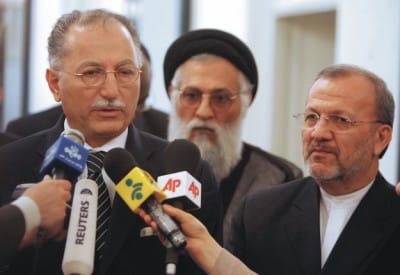
Iranian Foreign Minister Manouchehr Mottaki (R) is seen after meeting with the chief of the Organisation of the Islamic Conference Secretary General Ekmeleddin Ihsanoglu (L) in Tehran yesterday. Iran rejected US conditions for talks yesterday over its disputed atomic programme, saying it was ready for negotiations but unwilling to freeze sensitive nuclear work. PHOTO: AFP |

