A lifetime commitment to cinema
The unforgettable Raj Kapoor
Hard to believe, yet true. Actor, director and producer of numerable Hindi films that enthralled audiences across the sub-continent, Raj Kapoor embarked on his career as a clapper boy, assisting Kidar Sharma. Today marks 18th death anniversary of the legend who is considered to be one the greatest Indian personalities of the 20th century. At the age of 11, he appeared in his first film Inquilab (1935). However the real breakthrough was the hero's role in Neel Kamal (1947). The following year, he established his own studio, RK Films and became the youngest film director of his time. Aag (1948) was his first movie as a director, which won acclaim. The years from 1948 to 1988 were busy for Kapoor in his role as director. He went from one cinematic success after another: Barsaat (1949) to Awaara (1951), Shri 420 (1955) and Sangam (1964), also starring in many of the films. His frequent co-star was actress Nargis, also his real life love interest. On the heels of the box office failure of his grand 1970 film, Mera Naam Joker (which took over six years to complete), his films took on a sizzling and crowd-pleasing turn. Bobby introduced Dimple Kapadia, later an Indian superstar, and was the first of a new generation of teen romances. On its heels followed films such Satyam Shivam Sundaram (1978) and Ram Teri Ganga Maili (1985). Many of Kapoor's films had a patriotic slant. His cinematic works Aag, Shri 420 and Jis Desh Mein Ganga Behti Hai, celebrated the newly independent India and encouraged patriotism in his fellow countrymen. Kapoor also had the knack for recognising good filmi music and lyrics. Many of the songs he commissioned are evergreen hits. He also introduced the music directors, Shankar-Jaikishan and the lyricist Hasrat Jaipuri. Another forte was his superb sense of visual style. To complement the mood of the music, he used striking visual compositions, elaborate sets and dramatic lighting. To Kapoor also goes the credit for the debut of Nimmi, Dimple Kapadia, Zeenat Aman and Mandakini. His sons, Randhir, Rishi and Rajiv have all been associated with the Hindi film industry as actors, directors or producers. Kapoor was the eldest son of Prithviraj and Rama Kapoor. He was born in Peshawar, Pakistan. He was educated in different places as his father Prithviraj was then on the move. He studied in Peshawar, then did part of his schooling in Calcutta and eventually failed to get a form to appear for the entrance exam in Bombay's Antonia D'Souza High School. Kapoor came a cropper with his compulsory second language, Latin. Though he was a winner in the All India Elocution Competition for three years running, his disastrous marks in Latin spelt an end of his academic career. An interesting anecdote surrounds Kapoor's entry into the film world. Apparently Prithviraj asked him why he wanted to opt out of school and not make another attempt, he replied, "Sir, if I graduate what happens? If you want to become a lawyer you go to a law college; if you want to be a doctor you go to a medical school; and if you want to be a filmmaker, where do you go?" No wonder his father was stumped for an answer. Over the next five years, he learnt the different arts of filmmaking in all departments as an assistant. In 1944, he joined his father's Prithvi Theatre and was responsible for the backstage work, right from the lighting of the sets, sound effects and music to art direction in their first stage play, Shakuntala. In the second play, Deewar, he enacted the small role of a boy servant. Subsequently, he starred in the famous Prithvi Theatre epic, Pathan. The rest, as they say, is history. Compiled by Cultural Correspondent.
|
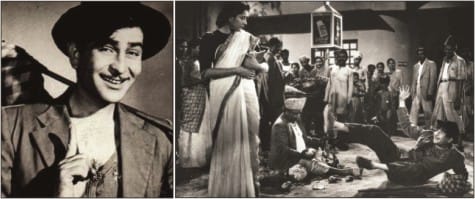
With Nargis (R), Raj Kapoor (L) created one of the most popular on-screen pairs in Indian Cinema |

