Workers' rights and dignity
Commodore AMA Alam (Retd.) BN, New DOHS, Dhaka
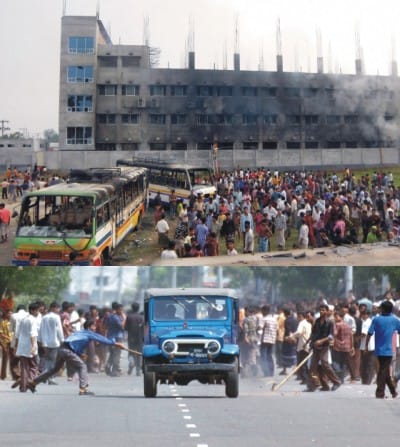
The existing labour laws of Bangladesh are applicable to all, whether there exists any labour union or not. The labour law prohibits certain things and make certain things mandatory for the employer. Things like maximum working hours in a week / day including overtime, weekly holidays, subsidised food when employed on overtime, annual leave, maternity leave, working conditions like sufficient lighting, ventilation, safety measures like fire escape, fire fighting measures, first aid etc. etc. must be in place. The government has the responsibility to ensure that the labour laws are strictly adhered to. Forgetting the wage structure, if the working conditions are improved and relation between management and workers are cordial one can be sure that there exists a minimum possibility of any labour unrest. The other day it was alleged by a garment worker in a television interview that her colleague got a slap by the manager, that too a foreigner. How dare he could do that? Are we living in the 18th century that our workers should get the treat of black days that existed before the industrial revolution. The government should take severe action against that Foreign Manager and immediately deport him. If the relation between the management and the workers are not cordial in one factory, the others may be affected. So one has to nip these sort of happenings in the bud. Secondly, there exists a big gap in the life style of one small group of people with that of the majority. If majority cannot even afford to take a bus, how a tiny group can come to work place in luxury cars. Garment workers in thousands walking miles is a common scene in the early morning and late evening, only because they do not have money to get into a bus. Finally, this must be borne in everybody's mind that productivity can be increased many times if you have a happy workforce, they not only will increase production, will also protect your assets from outside enemy. * * *The recent demand of many labour organisations & NGOs (& also some buyers) is that it's about time the govt. increases the workers' minimum salary from the existing Tk 930/month, that was introduced in 1994, to Tk 2500-3000. My question is why should the govt. get involved in private enterprise salary structures? I mean, is there any other trade (apart from the garment industry) , where the government imposes such minimum, be it the car mechanic's workshop, day labours, or even domestic helps. ..(who work 16-18 hrs shifts). In market economy, the salaries of employees are based on their ability, the importance of that trade, and most importantly the demand-supply factor. Today, say the minimum salary structure of an entry level garment worker (i.e. an assistant with no experience) is Tk 930 ( plus overtime which turns out to be another Tk 600-700 per month) , which frankly speaking is not very less compared to many other trades' entry level salary. A skilled operator earns a minimum Tk 3000-4000 per month, with overtime included. (Which is higher than many graduates are earning in private firms!). Now, as in any trade, if the supply of the workers/employees is more than what the factory/company needs, the employers will obviously not be compelled to change the minimum salary structure. Moreover, workers who are applying are well aware of these salary structures. It's no secret that the success of Bangladesh garment sector is because of low labour costs. This is the only strength the industry has. With the lower profit margins, because of global competition, plus higher compliance requirements from buyers, it's not a feasible option to raise the workers' salary three times at one go! Tanvir, Dhaka Cantonment, Dhaka
|
|

