Short Story
City Shoes in The Village - Part I
Mahmud Rahman
There would be no familiar faces to greet him when he arrived. But Altaf could expect the children to hear his call.The dub-dub rhythms of the engine spread out and beckoned every boy and girl within earshot. Their short brown legs kicking up a cloud of dust, they flocked to the riverbank. They jumped up and down, their shrill voices piercing the air. Altaf had encountered this scene a hundred times as he made his way east from Calcutta through the tangled waterways of the delta. This time his motorboat did not rush past the children. It slowed down and headed right toward them. Their jumps turned into stomps and their shouts became screams of delight. When he cut the engine, Altaf heard what they were saying. Ingreji-sahib! Ingreji-sahib!
From the back of the boat, Shiraj chuckled, "They think you are an Englishman." Altaf smiled. Why not? These children might never have seen the English, but everyone knew they were the masters of this land. He doubted that any other motorboat had ever come into this village. No one would expect a Bengali man to bring one here. Exhausted after three days of travel, Altaf was relieved the journey was over. When he had turned off the Meghna River and entered this smaller channel, he was not sure this was the one that led to his village. He was returning after ten years. "This is Modhupur village, isn't it?" he shouted at the children. He-speaks-in-Bangla. Not-an-Ingreji-sahib! Our-folk! One-of-us!
He repeated his question. Yes-this-is-Modhupur. But-who-are-you? Who-do-you-want? Where-did-you-come-from?
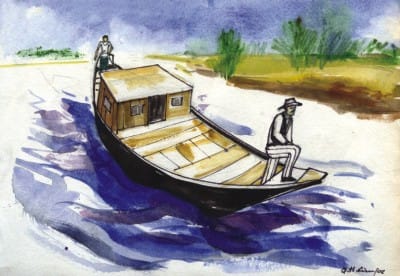
"I belong to that house over there," he said, thrusting a finger toward the palmyra trees. The children swiveled their necks to look. None of them were old enough to remember him. A voice made itself heard over the rest and said, Masoom's-uncle-who-went-away-to-the-city. It could have been the certainty in his voice slightly older than the others or they may have run out of possibilities to consider, but the boy's remark settled the debate. The children quieted down and just stared at Altaf, as if searching his face for some sign of familiarity so they could place him as part of their world. Clutching the mooring rope in his hands, Shiraj jumped into the water and tugged the boat toward the bank. The children craned their necks to look inside the boat and resumed their inquiries. Where-are-your-sails? How-can-it-move-without-sails? What-is-that-thing-you-call-an-engine? Leaning over the bow of the boat, Altaf passed his bedding and leather suitcase to Shiraj. He balanced himself on the edge of the hull, then leaped onto the bank. His eyes scanned the boat: Four years it had taken to build, and it had now brought him home. Painted blue, a sleek fourteen feet in length, the vessel had been fashioned with a few good planks along with many bits and scraps of wood. He built it in country-boat fashion, skin first, frame at the end. A cabin rose above the back of the boat. It was little more than a roof, but it shielded the engine from the rains. Then, armed with only a compass and some maps, he piloted the boat through the crocodile-infested Shundorbon forests and found his way to Modhupur. "Stay here," he ordered Shiraj. "Keep a careful eye on the boat." "Just go on," Shiraj replied. "Everything will be fine. Have I let you down yet?" Altaf nodded. At thirteen, Shiraj was already a seasoned boat boy. He had been born in a lower delta district known for sending off its young men to work on boats and ships in Bengal and across the oceans. He came to Calcutta on a cargo vessel and jumped at the chance to work for Altaf, who was then building his boat. When they embarked on this trip, Shiraj had been thrilled. His village only half a day's journey from Modhupur, he asked Altaf if they could take a side trip, even for just a day. Altaf had given him a non-committal reply. With the children leading the way and the mid-afternoon sun shining down on them, Altaf felt like he was part of a festive procession. It was nothing like the darkness of night in which he had slipped away as a young man of eighteen. That other night he had left along this same path, but only his kid brother accompanied him then. Kamal had insisted on coming to say goodbye. They stole out of the house together after Altaf tiptoed over to their father's cashbox and lifted a hundred rupees. At the water's edge the brothers parted. Altaf boarded the boat that would carry him to the nearby riverport on the Meghna. From there he would catch the steamer to Calcutta. The last image he remembered from his village was Kamal on the riverbank, sobbing. He asked the children when it had last rained. A week ago, they said. He looked up at the sky. Not a rain cloud in sight. A good sign. He hoped it would remain this way. Altaf surveyed the landscape around him. Everything looked as it had ten years earlier. Flat and motionless, the village slumbered. A few cows lazed in the shade of roadside trees, chewing their cud. In the distance some men labored in the fields, their faces hidden by their large bamboo hats. Altaf suddenly felt the emptiness in his belly. He had not eaten since daybreak and now his mouth watered for his mother's cooking. Altaf was surprised by how quickly they reached the family compound. He remembered a longer distance. When he stepped inside the courtyard, he was shocked at how small it was. The house was new to him. The three-room brick house had been finished two years earlier with money he had sent home. He was disappointed to find it looking so shabby. The whitewash on the walls had grayed, streaked by rainwater stains. Some of the plaster had fallen off, leaving holes through which the brickwork gaped. An old woman, dressed in a frayed white sari, emerged on the small verandah from inside, rubbing her eyes and complaining of the noise that had woken her up from her nap. Her eyes focused on Altaf and she bounded forward, shouting, "Altaf, you've come!" He steadied her, bent down, and touched her feet. She pulled him up and wrapped him close to her. Tears rolled down her face. "We got your letter that you were coming, but you didn't tell us when. Your brother is off on some errand. He has so much on his hands. Here, let me take a look at you." She held him away from her and took a long gaze at her son. "Ma," he swallowed, hard. Water rose in his eyes. "Are you ill?" "I am just tired. I get tired easily these days. But now that you're back, I shall be fine." Her face beamed as she wiped off her eyes with the end of her sari. She asked him what he wanted to eat, but he replied that he would be fine with whatever she had cooked for the day. "Of course you would say that. You haven't changed one bit." She ordered a young girl standing nearby to start preparing a new meal for the evening. They sat on low stools on the verandah, facing each other. He gulped down the coconut water, then surprised her with the news that he had come on his own motorboat. "Your motorboat? You own it?" "I don't just own it, I built it." He grinned. "You must come see it." "There will be time enough for that later." She waved her hand, her palm fluttering in that gesture that made him feel like he was twelve years old again and his mother had ignored his plea to come see one of his playthings. Perhaps she saw the cloud falling over his face, because she continued, "You were always good with your hands. I remember those toy boats and carts you would build with leaves and pieces of bamboo." His face lit up. "That was nothing. This took a long time to put together." "How much did it cost you?" Altaf nearly blurted out how much money he had spent on it, but he stopped when he realized that the boat had cost almost as much as the money he had sent home to build the brick house. He quickly made up a figure. It was still a large sum, he could not conceal that. She frowned. "What do you plan to do with the boat? Is it for business?" "No. Not right now anyway. I go on trips on my day off from the job." "So much money on something just for fun?" She sighed, tilting her head to one side. "Aren't you too old to be playing with boats? Shouldn't you be starting a family by now?" Altaf remained silent. He grabbed a machete lying near him and split open the coconut. Slicing a sliver off the green skin, he used it as a spoon to eat the soft meat. "This is delicious. They don't taste the same in Calcutta." "Of course not. How many days are you staying?" "I can only stay for two weeks. My vacation is three weeks long, but the journey back and forth takes a week." "You don't come for all these years, and you only give us two weeks? You could have asked for a full month's vacation." She, with some effort, rose to her feet. Altaf wished she had asked him to stay longer. He did not remember her to be so accepting of his ways. Had she given up on him as lost for good? The truth was, he did have a month's vacation, but he had already used up a couple of days before the trip and he wanted to keep a few days in reserve in case something went wrong. There was also Shiraj's request to consider. He could probably stay an extra day or two, but he wanted to make sure he felt comfortable before he offered those days to his family. He excused himself and went to wash. Her response to his boat dismayed him. So much money just for fun, she had asked, appearing to encircle that last word, fun, with scorn. But should he have expected otherwise? Her life was one of duty, her concerns practical, focused on family and household, and her pleasures mostly sensory, and that too, coming in ever tinier portions. He was now asking her to accept a concept of leisure which belonged more to the English colonials or the Bengali aristocracy, people who inhabited the far reaches of her universe. How could she know the pleasure he enjoyed by owning a boat of his own, one that allowed him relief from his paper-shuffling job? How could he explain to her that he needed this boat to feel less lost in the city? His boat transported him out of Calcutta to the vicinity of villages that had the scents and vistas of home. It gave him pleasure to know that these waters and the rivers near Modhupur both originated in the same streams coming down from the Himalayas. If he told her such a story, she would ask him to simply move back home or make more frequent visits. His brother would surely understand. ***** Mahmud Rahman is a Bangladeshi writer who lives in Oakland, California.
|