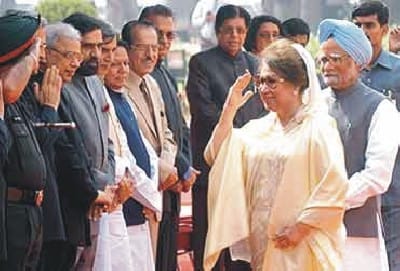
Bangladesh-India relations enters constructive phase
Mohammad Amjad Hossain
Geo-political compulsion dictates that laying foundation of friendly relations with neighboring countries in the first place should be the cornerstone of Bangladesh's foreign policy. Therefore, it should logically be dictated to focus primarily on its giant and closest neighbour India, surrounding from three sides. Bangladesh and India share 4,000 kilometers of border and 54 rivers as well. India, with roughly eight times its population and more than twelve times its GDP should be the major attention of Bangladesh.Mistrust and suspicion between Bangladesh and India have constantly been hampering the process of developing friendly relations. Disputes over sharing of waters from the Ganges and other common rivers, demarcation of land and maritime boundaries, exchange of enclaves coupled with accusation and counter accusation of harbouring insurgents have persistently been the major conflicts. India has been constructing barbed wire fences along the border to stop illegal immigration from Bangladesh and cross border smuggling as well. Bangladesh considers this as an unfriendly act. The coalition government of Bangladesh in fact so far ignored the perception of building up friendly relations with its closest neighbour, India, which is now considered an emerging global power. Having become the Prime Minister following the general elections in 2001, Khaleda Zia has opted to visit China with whom India did not have best of relations. That visit was not well received in New Delhi . Of course, the relations between India and China have considerably been improved since then. The visit of Bangladesh Prime Minister to China at that time was seen from New Delhi as an insult, which might have caused an irritation in bilateral relations. Last year Prime Minister decided to pay a visit to Pakistan, which is an arch rival of India. Bangladesh 's support for withdrawal of ban on Pakistan by the Commonwealth went against the stand of India. One can think about the implication of such visit to the countries inimical to India 's interest. This is not to suggest that she should not visit China or Pakistan. It is equally important to have a balance of relations being a small country with per capita income lowest in the region. Needless to say basic determinants should be identified for the formulation of foreign policy and of course, national interests should take precedence over other determinants. During the visit two agreements, such as revised trade agreement, which stipulates that both countries would make mutually beneficial arrangements for the use of waterways, roadways and railways for the passage of goods, and joint efforts to check the trafficking of narcotic drug and psychotropic substance were signed. Bangladesh government gave concession to Indian side by allowing Bangladesh territory for transportation of Indian goods to India's North-Eastern states. Under the agreed arrangement, Bangladesh trucks or boats would transport Indian goods from one to another border point. There is another area where Bangladesh can take pride of as India has assured of increasing investment in Bangladesh to narrow the widening gap in bilateral trade, which is heavily in favour of India. Another positive development is operational train link between Joydebpur in Bangladesh and Sealdah in West Bengal, which would provide people to people contact between the two countries. These arrangements along with combined operation to face terrorism would facilitate improving bilateral relations. Having said that the relations would improve, but given the time frame it is really hard to implement the decisions. The coalition government in Bangladesh could have achieved more success had the administration initiated such action with India on assumption of power in 2001. The Prime Minister's first visit in five years is seen from upcoming elections perspective in Bangladesh, which will be held in January, 2007.Only seven months are left to the formation of caretaker government. In seven months time no tangible results could be expected from the agreement. From publicity point of view, such visit could provide dividend in the coming elections. However, a base for improving relations has been laid out which the future government could work on for further strengthening. Mohammad Amjad Hossain, a former Bangladesh diplomat resides in Virginia.
|