Zooming in on professional photographers
In conversation with Dr Shahidul Alam
Fayza Haq
Dwelling on what made him create Drik, Dr Shahidul Alam, sitting in his gallery, recently, says, "It was largely a response to what was happening: I was at that time, representing an agency in London, and I looked at their entry requirements for extending support to photographers. I realised that there was no way a photographer, say in a country like Bangladesh, could provide that sort of material. The local photographers needed far more support than was provided by these agencies. So, the western model was inappropriate for us."Also, it was important for it to be based here: an agency in London didn't really meet the requirements of a photographer here. This is not only in terms of language but also accessibility: in terms of providing the physical structures and the guidance that will be needed to set up a little platform to provide that professional support. That was the idea behind setting up Drik." Dr Alam says, that conceptually the reason for setting up Drik, had to do with challenging the way many countries are portrayed. These countries are known for poverty such as Bangladesh, although there is so much to know about this country. He felt that western photographers are the only ones portraying a country like Bangladesh and they will continue to portray the same negative stereotypes. To challenge that, he says, you need local practitioners with better understanding of local conditions and a cultural sensitivity. Pathshala, he says, came much later. The idea at that time was to conduct training. While Drik needed to be set up, he says, one had to set up a centre for academic training, which was needed, if photographers were to be given much more hands on support. They needed tutoring and mentoring, he says, and therefore there was a need to set up a full-fledged academic structure, which would provide a different type of support. Drik, he says, continues to provide support for established professionals, but Pathshala, plays a very different role, providing far more support in terms of providing educational facilities, which professionals at Drik aren't able to do. Dr Alam says, "In Bangladesh, we lack photographers at the very top level, that for instance, India has. However, we're miles ahead of countries such as Pakistan, Sri Lanka, Nepal, and even Singapore, Malaysia and Afghanistan." Asked to name some of the Bangladeshi photographers, he mentioned photojournalists like Abir Abdullah, Akash, Momena Jalil. Outside photojournalism, there is Sanjida Sheikh and S A Kiron; considering the much more senior photographers, there is Rashid Talukdar. Dr Alam says, "I believe that the younger photographers have far more potential, as they have had the classical training and their fundamentals are far more solid in their case." The younger generation have all been trained at Pathshala and the teachers, at one time, were all a visiting faculty comprising of overseas tutors, who were the finest professionals, Dr Alam says. Some said that the quality of education in this line was far superior to that of overseas. Over the years, there are a lot of foreign tutors coming to Pathshala. Dr Alam's family -- in the late '70s when he was doing his Ph.D in Chemistry in UK -- when he began as a photojournalist, did not consider photography as a viable profession. "Today, things have changed," he says, "as the environment is different as many of the good newspapers, such as The Daily Star are hiring photographers so that they are earning a decent living, and have prestige in society." Dr Alam is a much sought after photographer, with many overseas awards to his credit.
|
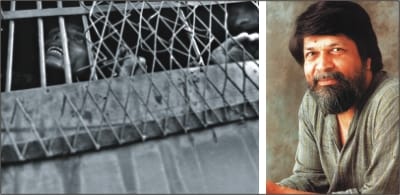
A gripping photograph by Dr Alam. Courtesy: Drik |

