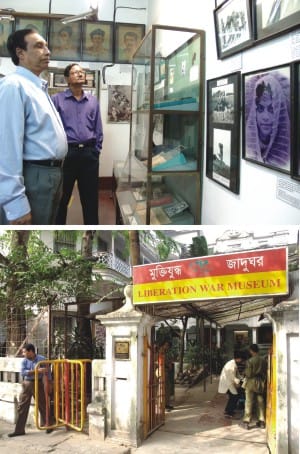
Liberation War Museum
Display of artefacts curtailed for want of space
Faizul Khan Tanim
With the approach of another Victory Day, the Liberation War Museum is crying for space to display its artefacts, which are increasing every year. Liberation War Museum sources said that many new authentic and interesting artefacts concerning 1971 were found but cannot be well displayed because of insufficient space. The rarities are displayed in shifts enabling enthusiasts to have a glimpse at as many items as possible. The recent exposition of new exhibits in the form of banners and posters displaying pictures of the sector commanders and facts on the international support received during the Liberation War is attracting more visitors and enthusiasts. The panels have information of the sector commanders, the area of operation and important dates and notes about specific battles at a glance. Along with these, the International Support panel displays facts about countries that supported Bangladesh in 1971, said Dr Sarwar Ali, trustee and member secretary of the Liberation War Museum. The members of the museum are still looking for a suitable place with ample space to display artefacts. A year has already gone by and the trustee members are now still looking for a permanent place for the museum instead of the rented two-storied building. Renovation of the auditorium in its present location is on and the re-arrangement of the items will give the museum a new look. Many events in a seven-day long programme are earmarked to celebrate Victory Day starting from December 10. The programmes starting at 5:00 in the evening will include speeches, plays, and musical events, open discussions and recitations by eminent artistes related to highlighting the facts of Liberation War to the present generation. An interesting recollection on Dhaka in the 60s and 70s will be made by Margaret Blood, wife of Late Archer K Blood on December 15, said a museum official. Blood died on September 3 last year. He was the Consul General who in 1971 sent the famous wire known as the 'Blood Telegram' signed in Dhaka by 20 members of the U.S. Consulate General, to the US government on the Pakistani military's operations. The cable charged: "Our government has failed to denounce the suppression of democracy. Our government has failed to take forceful measures to protect its citizens while at the same time bending over backwards to placate the West Pakistan-dominated government." With this Archer Blood was transferred from his position and placed into virtual exile within the State Department, who later became a Liberation War casualty and was punished for simply speaking what he felt was the truth. The Liberation War Museum is the only private museum in the world, founded 25 years after the independence of Bangladesh; an institution which should have been constructed by the various changing governments of the country. When a few freedom fighters were asked on how they felt, one emphasised on the security of the museum that houses many important documents right now. But the privately owned only Liberation War Museum till now is in the best condition when compared to the other government memorials in the city like Mirpur Intellectuals graveyard, Rayer Bazaar Martyred Intellectuals Mausoleum, and Savar National Martyrs Memorial.
|