Book Review
Blueprint for the War on Terror
Ron Chepesiuk
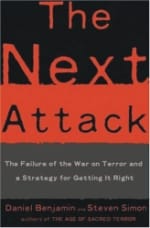
In a memo leaked to the press in the fall of 2002, Secretary of Defense Donald Rumsfeld posed a question to his aides: "Is this a case in which the harder we work, the behinder we get?" It was a revealing rumination from a key Bush administration official about the course the War on Terrorism. Yet, despite the free falling opinion polls and growing public discontent about our mission in Iraq, the administration has given no indication that it's willing to admit mistakes and re-assess its foreign policy.In "The Next Attack," David Benjamin and Steven Simon answer Rumsfeld's question. They argue that the Bush administration's failure of leadership and inability to develop a comprehensive strategy is causing the US to lose the War on Terrorism (WOT). As the authors explain: "Only two indicators are used to show the measure of our progress in the War on Terror: the number of days since 9/11 in which we have not experienced a second cataclysmic attack, and the number of al Qaeda members who have been apprehended or killed." The book is timely and the authors have the credentials to challenge the Bush administration on its WOT policy. Benjamin and Simon are distinguished foreign policy experts who served on the National Security Council during the Clinton administration. They co-authored the award winning "The Age of Sacred Terror: Radical Islam's War Against America," which has made them leading experts on al Qaeda. And as their sourcing for this book shows, they have extensive contacts in the corridors of power. While the authors cover the usual topics (weapons of mass destruction, intelligence failures, the neo con establishment, etc.), they also provide new information based on fresh sources who worked inside the Bush administration. For example, one State department official told the authors about a January 2002 meeting during Martin Luther King weekend in which the Bush administration planned the invasion of Iraq. "The original idea was to go war by Tax Day (April 15) 2002," the official revealed. Unlike the many other Bush administration critics, moreover, the authors present a plan for "getting it right." Any winning strategy, they contend, would have to begin with cutting our losses in Iraq. The capital we gained in destroying the terrorist base in Afghanistan was squandered when we invaded Iraq. The country is now a haven for terrorists, and the Iraq War has escalated the potential for violence against the US and our allies, making us less safe. Meanwhile, the war is fueling anger in the Muslim world and creating a seemingly inexhaustible supply of terrorists. While agreeing that spreading democracy in the Arab World is a worthwhile foreign policy goal, the authors maintain that "a policy based on rapid withdrawal (from Iraq) is necessary to limit the damage we have already accrued." Their thorough discussion of Bush administration plans to democratize the Middle East show how simplistic and perhaps unrealistic they might be. In reality, the obstacles are formidable, and US policy needs to take into account the region's deeply embedded cultural factors and fundamental political and economic realities. They warn that "any attempt to change them should be made with some humility and understanding that the results we want are not guaranteed." The book was written well before the recent violence in France's largely Muslim ghettos, but this development illustrates one of the book's major points: "Islam's strategic depth." They predict that the "tensions will worsen in the coming years as Europe's demographic crisis and its antipathy to outsiders sharpens-as Christian Europe continues to shrink and Muslim Europe grows." No empire can be an island, and developments in Europe and in other terrorist flash points will have implications for the US. The old versus new Europe debate aside, that's a good reason why we need strong allies in the WOT. Another important element of their strategy is for the US to dispense with its futile military solutions. While agreeing that pressuring state sponsors make sense, they document how state sponsorship of terror has been waning for years. Cell-based units, not state sponsors, are at the heart of the terrorist movement. So building stronger links with foreign law intelligence and law enforcement agencies, especially in those developing countries should be a high priority. One may not agree with everything in the authors' critique and strategy. Some Bush administration supporters would argue that preventing new attacks on US soil since 9-11 shows that it's doing a lot of things right. But a lot of things are obviously wrong, and Benjamin and Simon do offer sincere and sage advice on how we can strengthen the country's anti terrorism strategy. Plenty of evidence strongly suggests that it's time we move beyond the rhetoric of "The Axis of Evil" and develop an intelligent and comprehensive plan to defeat our Jihadist enemies. As the authors frame the challenge: "We must decide whether we want a strategy for this conflict or a theology. How much blood will be shed depends at least in part upon that choice." Daily Star columnist Ron Chepesiuk is a visiting professor of journalism at Chittagong University and a Research Associate with the National Defense College.
|