Non-partisan Speaker needed
M. Abdul Latif Mondal
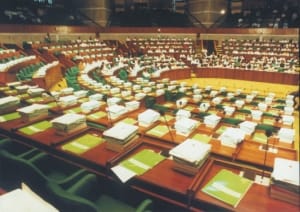
The Daily Star of November 24 reported that on November 23 the Speaker of the parliament Jamiruddin Sircar "rejected all the opposition lawmakers' demands for discussion in parliament on different issues including rise of militants and price hike of essentials." The Speaker reportedly said that the government was seized of these problems and trying hard to solve them. So, there was no need for holding any discussion on these issues. The 19th session of parliament that began on November 20 was prorogued on November 24 without transacting any major business, including enacting laws. The Speaker's rejection of the opposition lawmakers' demands to discuss burning issues like terrorism, price spiral of essentials, gas and power crisis is contrary to the recent assertion of the Prime Minister in the 18th session of parliament. While addressing the parliament on September 8, the first day of the 18th session, the Prime Minister and Leader of the House Begum Khaleda Zia said that they considered parliament as the most appropriate place to discuss all the issues of national importance. The Speaker's rejection has astounded the conscience citizens of the country and given rise to the question as to what more important issues could be discussed in parliament. The Daily Star in its editorial of November 25 thus wrote: "The issues on which notices were served for discussion in parliament on Wednesday are evidently not partisan matters, they are national issues and should be dealt with accordingly at all levels especially in the House of the people. Our entreaties are with the Speaker that he broadens his approach and vision." Bangladesh has adopted a parliamentary system of government. The essence of a parliamentary system is that the government remains under constant scrutiny of the parliament. While the executive is responsible for governance, the parliament is responsible to control the executive. So, the primary function of the parliament is to control the government. Herein lies the need for a non-partisan and courageous speaker, generally known as the guardian of parliament. Failure of the Speakers to play their role neutrally and courageously during the period of successive political governments has been one of the most important, if not the most important reasons for ineffectiveness of our parliament. Moudud Ahmed in his South Asia Crisis of Development: The Case of Bangladesh (2002) thus writes: "Unlike in India, and other more developed countries, the Speakers in Bangladesh have played a blatantly partisan role. In both the parliaments, under the BNP and the Awami League, the Speaker functioned under the influence of the respective political governments. This is one of the reasons why politics in parliament failed to grow. There was very little difference in the behaviour and approach towards the opposition between the Speaker under the BNP government (1991-96) and the Speaker under the Awami League government (1996-2001). Each of them was under constant political pressure of the party they belonged to and failed to act independently. On all issues and not just the crucial ones, they only fulfilled the desire of the ruling party. Even in matters like the allocation of time and allowing notices and adjournment motions, the political interest of the ruling party would be the prime consideration." Political observers, civil society leaders and academics are of the opinion that the aforementioned situation has not improved, if not worsened, under the incumbent Speaker. The allegations generally leveled against the present Speaker are as follows: - As the guardian of parliament, his role in running the parliament has not been non-partisan. He has virtually proved his undoubted loyalty to the treasury bench rather than to the House itself.
- As the head of parliament which is one of the three basic pillars of the state, the other two being executive and judiciary, he has allowed the executive to interfere in the affairs of parliament.
- He did not take any serious initiative to bring the main opposition Awami League (AL) back to the House.
- He has rejected over one thousand notices on different vital issues submitted for discussion by the opposition lawmakers as the treasury bench did not agree to hold the discussions.
- He has failed to protect the rights of the legislators of the treasury bench to move a private member's bill in the House without the permission of the leader of the House. This restriction was imposed by the executive at the beginning of 2004 which goes against the spirit of rules of procedure (ROP) of parliament.
- During the last four years, there have been repeated quorum crises in the House. He has set a record by running the House without ensuring the quorum and presenting a novel explanation on formation of quorum.
- During the last four years, he has rushed to the Prime Minister's office on several occasions, ignoring the norms of parliamentary system of governance, and thereby has undermined the dignity of his office.
It is a fact that a nominee of the ruling party is elected Speaker. But that does not deter the Speaker from discharging his duties and responsibilities neutrally and courageously. In Britain, the birthplace of parliamentary democracy, the party in power proposes the name of the Speaker of the House of Commons and he "is unanimously elected at the opening of each parliament and remains in office till the life of parliament." The Speaker ceases to be a party man after his election. He does not participate in politics nor does express an opinion on political issues. He is, accordingly, recogninised as the non-partisan and impartial custodian of the rights of the members on the treasury benches and in the opposition. The essence of his impartiality lies in the way he maintains an atmosphere of fair play by ensuring that the opposition have an opportunity to express their views and criticisms, yet at the same time seeing that there is no parliamentary obstruction to hinder the government in its task of governing the country. Bangladesh has adopted the Westminster style of parliamentary democracy. Then, why cannot our Speaker emulate the Speaker of the House of Commons in Britain? This is primarily because of the fact that he, unlike his counterpart in the House of Commons, cannot continue in office for so long as he wishes no matter whether or not the party which first proposed him for the Speakership is returned in majority. Anyway, our present Speaker has served as a minister in more than one ministry. He served as the acting President of Bangladesh for two and a half months following the resignation of Professor Badruddoza Chowdhury from the presidency in 2002. If he can make any meaningful contribution to turn the parliament into an effective and vibrant institution, the nation will remember him in the days to come. What is needed primarily is his broadened and non-partisan approach to the affairs of parliament and this has become the need of the hour due to a number of reasons. First, apparently a favourable wind is blowing to bring the two major parties, the ruling BNP and the main opposition AL, to the discussion table inside or outside the parliament. The Speaker can contribute to the process by initiating sincere efforts to bring the main opposition back to the House assuring them that their grievances pertaining to the conduct of business in the House would be removed. The Speaker should write letter to the leader of the main opposition expressing the assurance and request her to attend parliament to save the nascent democracy. Telephonic talk should follow. Once the main opposition returns to the parliament, a favourable atmosphere to discuss there all issues of national importance may prevail. Second, a cursory look into the proceedings of parliament during the last 15 years of parliamentary democracy does not show "any bill was passed placed by the opposition, any amendment included in any bill brought by the opposition members, any private member resolution that was approved that had been placed by the opposition members." The AL-led 14-party alliance's proposals for reforming the caretaker system of government and the Election Commission are now issues of national importance. If the AL places these proposals in the House, and if the treasury bench members and the opposition find better alternatives in them after discussion, then further amendment(s) to the constitution or enactment of appropriate law will be a matter of formality. Here the Speaker can play an important role. Last but not the least, let the Speaker's broadened approach and vision in the performance of his duties create a precedent to be followed by his successors. To conclude, the nation is now passing through a critical stage. The confrontational politics of the two major parties, the BNP and the AL, will not ultimately help either of them. The sooner they realise it, the better it is for them and the nation. The Speaker can help them realise this if he can win the confidence of both of them. M. Abdul Latif Mondal is a former Secretary to the Government.
|