Exhibition
Young photographers display talent
Fayza Haq
External Counterparts, an exhibit of four young photographers, had a showcasing at Alliance Francaise on December 3. Nasir Ali Mamoon, the chief guest and patron, said that the work was excellent, keeping in mind the youths' age, drive and dedication. Nasir said, "Kadir , Fahim, Sahjib, and Asif, going by pet names, all in their early 20s, have had their training at Drik's Patshala. This is their first combined effort. I figure that the reason why they've gone in for 'black-and -white is because, colour has the most fascination for sophisticated photographers, as you can play with light and shade. Yes, there is more depth of perception of the image, imagination, and display of the latest oversees perception."Again, as you've reminded me, the latest, best international selection of photos, remains black -and -white. The most professional and creative photographers, world wide, remain black-and-white photographers. The most recent teachers of the four photographers, who're having their display are Shahidul Alam, Abir Abdullah and myself, among others." Asked to comment on their work, Shirajul Haque Shajib said, "My photo on Janmashtami's rally at the Dhaka University premises, which was held two months ago, focused on Krishna. The oscillating, scintillating flecks in the composition represent the flux of the rushing and joyous crowd of worshippers, and others: in other words, it's the rush of the rally." Commenting on his own work Shajib said," Sure, I've to work in the heat, at times, the downpour and the overwhelming dust and swarm of flies; but it's all a challenge and new adventure. If one goes in for black-and-white there are many complications e.g. the necessary paper and films are not easily available." His film processing is done at Drik, and Begart Institute. The labour of his toil brings in fruit, such as the sea of viewers, more than the expectation of the young photographers, like himself, he said. Speaking about his teachers he said that they are very understanding and amicable. They've a perfect rapport, he said. Md Anwarul Kader, speaking about his work experience, said that he had focused on the display of ostentation by the average individual in the Tejgaon industry, Dhaka. The silken woven shirt and silk shawl, along with the lighting of his cigarette, seen against the backdrop of the stopping train all go to drive home his point. He pointed out that photography as an art is a new genre in Bangladesh. People expect their photographs to be given to them, even when they were one in a crowd; others shy away from being photographed. However, looking at photography with an optimistic angle, he insisted that Bangladesh was a wonderful place to work in. He said that his source of inspiration were Nasir Ali Mamoon, Cartier Bressor, Eugene Smith and Alfred Stieg Lietz, among others. He hopes to bring in landscapes, such as that of Banderban and Sunderban, or social issues such as acid throwing or poverty alleviation. Chowdhury Luthfe Elahi and Rubayat Asif Iqbal, giving an overview of their experiences as photographers, added that in Luthfe's work he has focused on workers at Savar, believing in the dignity of labour. They said that black-and white photography best reflected their emotions, feelings and experience. Asif said in particular, he had focused on a tea-shop, thus throwing light on the pleasures of the Bangladeshi countryside. The exhibit was an impressive one, no doubt, for exhibiting the work of young "shutterbugs."
|
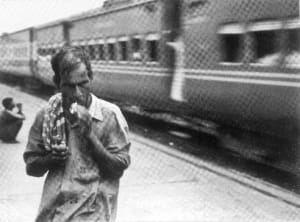
A photograph from the exhibition |

