Book Review
Indian Muslims and Communal Conflict
Azfar Aziz
Tremors of Violence: Muslim Survivors of Ethnic Strife in Western India is the latest, and a milestone, addition to the already impressive list of research publications by Dr. Rowena Robinson in anthropological, sociological and, to some extent, psychological dimensions of religion and communalism in contemporary India. While her previous studies were predominantly focused on Christianity and Christians, this one zooms into, interacts with and examines the riot-devastated Muslim communities of Mumbai, and Ahmedabad and Baroda of Gujarat. Her mission, as Robinson says, was "to walk the spaces and cross the thresholds of homes in an effort to comprehend the ordinary worlds and tragically extraordinary experiences of Muslim survivors of communal violence in contemporary urban India." It is also a courageous attempt to demystify the Muslim, who, "categorized as 'Other', taunted as Pakistani if not vilified as terrorist", is an "anonymous and frightening figure" in India.Since the pre-Partition and Partition-centred riots, Gujarat has suffered a series of major communal clashes in 1969, 1981, 1985 and 1990, in 1992-93 in the wake of Babri Masjid demolition and again in 2002, and several flare-ups in between. The frequency of communal riots is slightly less in the case of Mumbai, but in terms of intensity it outflanks the Gujarat towns. It is why the past is always present in the mind of riot survivors. "Every story of communal conflict leads back to stories of past conflicts, past violence," reports the author, and once again, "Every time someone speaks... there is a reference to a certain past experience of violence. Mumbai 1993, Gujarat 2002: for Muslims, for us, these are signposts of a nation out of hand. They present without any doubt two of the most horrendous attacks on Muslims in the post-Independence period. While the violence of Partition always lurks in the shadows of any discussion on communal riots, no experience may ever be wholly erased. Ahmedabad 1969, Gujarat 1985, Mubai 1974, Jogeshwari 1991, Baroda 1982, Bhiwandi 1984: the spectres of the past mercilessly haunt the present." As the book unfolds, it shows step by step how communal violence has changed the psychological divide between Hindus and Muslims into a physical one. In the heart of Ahmedabad, there are now 'border' areas -- streets and neighbourhoods partitioned on strictly communal lines. Families have moved and are still moving out of mixed neighbourhoods to live in single community areas. No one, she shows, appears to be willing to risk being isolated in a polarised society. It is this ghettoisation of body and soul, the rupture in time and space of riot victims as well as the actors, factors and dynamics of the 'pogrom' that constitute the core theme of this excellent work. She begins the first chapter, 'Inaugurating responsibility', with the rather harsh observation that in the "brutal" communal discourses in the last few decades, the Indian Muslims have been treated and scorned as Pakistanis, who should "go to Pakistan". "Indeed," she says, "as the social geography of Indian cities manifests, the Muslim in fact lives in Pakistan, many Pakistans, mini Pakistans." In vivid detail she illustrates how over the last decade Mumbai's social space has been deeply divided into communal pockets, where green and saffron flags are being increasingly used to demarcate 'Muslim' and 'Hindu' residential spaces, not just religious ones. Avoiding unnecessary generalisation, Robinson with admirable skill weavess the tales told by individual riot survivors of their shattering losses, painful attempts at ever-eluding recovery, and relentless struggle for survival into a colourful, multifocal, lucid and all- encompassing picture to let the readers have an almost first-hand knowledge. She does not tell but shows how the embodied markers of Muslim identity such as circumcised penis or a prayer cap or henna-dyed beard are jerked into the glare of ridicule and made violently noticeable. For instance, she makes the situation almost tangible by commencing the chapter 'Space, Time and the Stigma of Identity' thus: "Alighting at Sion station prior to walking down to Dharavi's famous '90 foot Road' I unobtrusively move my hand across my forehead and remove my bindi. I am entering Social Nagar, Muslim space on the social map of Mumbai." And then: "While riding to Juhapura on the back of a friend's two-wheeler, she urges me to pull my dupatta over my head. We are about to enter Ahmedabad's 'Pakistan'." In this study, partly funded by a Ford Foundation fellowship, the author scrutinises the differences between the communal riots of the past, which had a more intermittent and sporadic quality with the more methodical and deliberate persecution that has set in since the 1980s. "It was the 1980s and 1990s, during which Hindu-Muslim hostility and communal violence began to seriously take political centre-stage," she also observes. Based on the witness accounts of the interviewees, Robinson confirms the widely held accusation against the police and paramilitary forces of active connivance or passive concurrence with Hindu rioters in many cases, which, she points out, have devastating implications for India as a state. "Muslims," she remarks, "even more now than in the past, suffer both at the hands of rioters and the police: indeed, in Mubai's terrible violence of 1992-93, the most deaths occurred due to police firing and incidents of stabbing." As a citizen, the author rightly emphasises the urgency of correcting the situation to safeguard India, as an idea and also as a polity. "This is now for us a work, a labour in which, as scholars and writers, we have a crucial and critical involvement," she says with conviction. Dr. Robinson should be unreservedly commended for this superb demonstration of how bodies, space, time all get bruised and altered by violence. Azfar Aziz is senior sub-editor, The Daily Star.
|
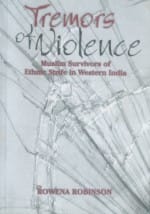
Tremors of Violence: Muslim Survivors of Ethnic Strife in Western India, by Rowena Robinson, Sage Publications, New Delhi, 2005, ISBN: 0-7619-3408-1, Paperback Price: Rs 295 |

