Book Review
The Master sans the Magic
Kazi Anis Ahmed
Salman Rushdie, in the novels that established him as a world figure of literature--Midnight's Children, Shame and The Satanic Verses--was a dealer mainly of the past. In more recent works he contends with some broad themes of contemporary life: fame and celebrity in The Ground Beneath Her Feet, and capitalist excess in Fury. Fundamental themes like rootlessness pervade them all. In his ninth and latest novel, Shalimar the Clown, Rushdie takes on the uber-issue of the moment: terrorism.The novel is apparently a response to 9/11 and its aftermath; however, it does not deal with either 9/11 or any of its principal actors--neither the "Islamist" terrorists, nor their "Western" opponents. Rather, it comes at the issue circuitously through another point of sustained contention; namely, Kashmir. While the novel is named after Shalimar the Clown, a Kashmiri folk performer turned terrorist, it has at least two other protagonists of equal importance: Max Ophuls, an American ambassador, and India (a.k.a. Kashmira) Ophuls, his daughter. Indeed, this brings up a vital question about this novel: why name it after Shalimar the Clown, when his centrality is not clearly established? The story is straightforward: Max Ophuls, French Resistance hero, and later an American ambassador to India, seduces the Clown's beloved, Boonyi, a dancing girl, producing a child. Ophuls' wounded wife, also a hero of the French Resistance, leaks the story of the out-of-wedlock child by way of revenge against her husband, and punishes the hapless dancer by taking away her newborn girl, Kashmira, and raising her in London. The dancer's simple-hearted husband, Noman, a.k.a. Shalimar the Clown, is so enraged that he joins the Kashmiri resistance to learn the arts necessary to attain his revenge against the ambassador. The resistance also leads him to contacts with international terrorist networks, which he uses as a channel to reach his destination, while offering his services as an assassin in return. Shalimar the Clown avenges himself over two decades after the original insult by murdering the ambassador in Los Angeles. The final section of the novel deals with Kashmira/ India's response to this murder. She sets out to search for her roots, and in addition to the story of her origins, she finds love with a Kashmiri man. These are the resources that fortify her for a final confrontation with the Clown. In typical Rushdie fashion, personal stories are deeply entwined with public history, but the ironic or playful ties here lack the frisson of discovery, and the authentic insight that gave his early works so much power. In recounting Indira Gandhi's Emergency in Midnight's Children, the shenanigans of Ziaul Huq in Shame, or the London race riots in the Satanic Verses, Rushdie was writing history-as-fiction at its highest: he was giving life to histories that had yet to find full expression in the genre of history itself. However, the history of the French Resistance here reads like overheated journalism, and the portrait of pre-partition Kashmiri life reads more like fairy-tale than history. Certainly, the literary Kashmir is not just the historical Kashmir, but also the symbol of an ideal. It is a place where Hindu and Muslim were mere "descriptions," not automatically "divisions." In this pre-Partition idyll, when Boonyi and Shalimar the Clown's under-aged affair is discovered, the panchayat decrees that they get married because: "To defend their love is to defend what is finest in ourselves." Though absurdly idealized, the sentiment of this verdict constitutes the visionary spine of this novel. In this story of love and revenge, where the public intersects the private in devastating ways, what remains important is the defense or possibility of love. Despite the twisted burden of her inheritance, India/Kashmira is supposed to be liberated or redeemed by her renewed capability to fall in love. While the sentiment is a worthy one, it fails to be moving, because the characters are not well-rounded with any feeling of reality about them. Rushdie, true to his penchant, makes much of not only the naming of Kashmira, but all significant characters, even places, making them laden with symbolic weight. Yet, his heavy-handed characterization is not enough to make the symbols resonant. Questioning the credibility of characters may be critiqued as a dated way to read fiction, but this novel is not premised on magic realistic terms, and the conventions of realism demand that characters come across as rounded creatures with an illusion of autonomy and depth. None of that is achieved here, because the characters are subjugated to the service of a pre-meditated schema; but by failing to develop them properly Rushdie fails the scheme as well. The novel is rife with events that stretch credulity, most visibly: the sophisticated ambassador Ophuls, and his super-sophisticated daughter India, falling in love with half-educated Kashmiris. More distressingly, for a novel ostensibly about terrorism, the personal revenge quest of the Clown does not illuminate us about modern terrorism. Is personal desire, rather than ideology, really the prime motivator for the self-exploding hordes? If the point is that all terrorists are driven ultimately by some personal motivation, or that both terror and revenge are born of love corrupted, these points are rather too banal for a novel-length treatment. Rushdie went into hibernation after the infamous fatwa. His first forays back into literature were treated with kid gloves by the literary world for obvious reasons. The faithful have waited ever since, however, to hail a new Rushdie book as a ground-breaker on the scale of at least Shame or Satanic Verses, if not Midnight's Children. Sadly, not one book since then comes close to fulfilling such an expectation. I cannot speculate what would give the master his magic back; but possibly its recovery lies in trying something new, not in reworkings of the same template. What made Rushdie a world figure was his ability to find an entirely new idiom, and the thrill of that discovery gave his inventions and his language their unique, electric charge. It does not happen here; but fans will wait to see if he can approach fiction again in the spirit of discovery that is the form's greatest purpose and invitation to its highest practitioners. Kazi Anis Ahmed is Director, Academic Affairs, University of Liberal Arts, Dhaka.
|
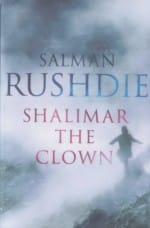
Shalimar the Clown by Salman Rushdie; London: Jonathan Cape; 2005; 398 pp. |

