The search continues, as does the challenge
Architect Dr. Nizamuddin Ahmed
Ever since Man stuck his head into a cave or sat under a tree to protect himself from the elements, he has sought building materials to suit his need and purpose.By divine blessing in the form of nature's motherly support and the perseverance of the gifted, throughout history Man has been able to discover, often at the nick of time, materials of the strength, durability and economy, that was the demand of the era. Fabric structures, as being presented by Ashikur Rahman Joarder and Kaniz Sultana Sathi, are perhaps a response to such a call. Like most other countries and regions around the world Bangladesh has generally three types of building materials: the indigenous, the hybrid (made or assembled locally with part or wholly imported materials), and the wholly imported material in finished form. While natural resource limitations will compel us to always import parts or whole of materials from elsewhere, which is not unusual in the global context, local entrepreneurship and expertise have been able to reduce dependence on bulk import of some materials in their finished state. For instance, for quite sometime now fabrication of aluminium channels is being carried out locally, although the bulk material is imported. More recently, private enterprises have successfully occupied much of the ceramic tile market in the country, given that some constituents have to be brought from outside. These are welcome signs that are often not heralded with due recognition. Fabric from natural fibres has been the primary material in our shamianas for long. It has also been used for interior décor and festive portals. This paper however deals among uses with fabric in outdoor structures, permanent too. Initially, the material may have to be imported. But it is hoped, and with justification from the growth of other building materials, that its acceptance and widespread use may prompt local industrialists to take up the challenge. That day may not be far when fabric as a building material shall be used and produced by our own. The author is Professor, Dept of Architecture, BUET and Consultant to the Editor on Urban Issues
|
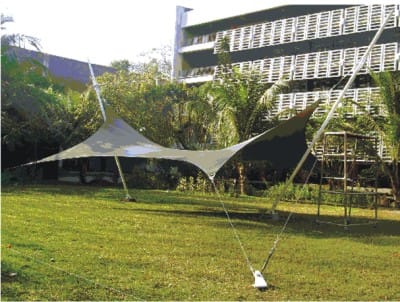
Project of the students of Architecture, BUET based on fabric structures including a successful true-scale interpretation, reflects the interest on the structural system among the learners and adaptability of fabric in different climatic regions including tropical areas. There is immense possibility of using this material in Bangladesh. Presently, its unavailability and limitation of technical knowledge are practical hindrances. Structure designed and implemented by STUDIO- VI (ARCH 304), 2005, Dept. of Architecture, BUET, Dhaka |

