Human development catastrophe since 2001
Zakaria Khondker
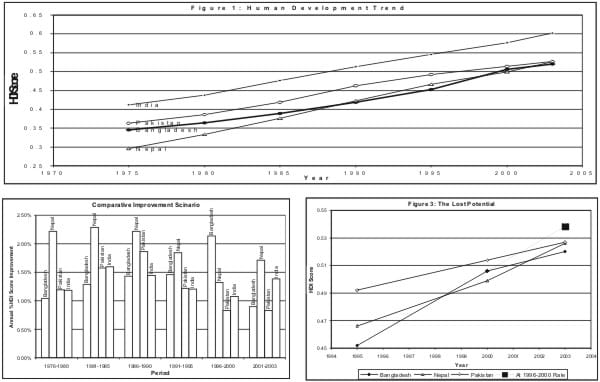
Recent media focus is emphasising more on the Corruption Perception Index (CPI) rather than the more important and statistically robust indicator, Human Development Index (HDI). CPI is a quantitative measure of some qualitative surveys of perceptions that can be subjected to what people actually think rather than what actually is; people in different countries can define corruption very differently. Another problem is that due to lack of information, CPI uses different data from sources for different countries, making country to country comparison susceptible to criticism.Imagine a number that is averaged over millions, perhaps, billions of numbers, whose minor change can impact the lives of millions. A single number based on facts instead of perceptions that takes into account peoples health, education and living standard all together and holds an indication of where a country is heading for the future. The United Nation's Human Development Index (HDI) for a country is based on a score computed from three leading indicators: long healthy life, achievement of knowledge and living standard. These factors are measured by 1) life expectancy at birth, 2) literacy rate, and school enrollment and 3) Gross Domestic Product (GDP) per capita adjusted for purchasing power (PPP). Unlike CPI, HDI is much more robust and more objectively measured and it allows for year to year comparison. All these measures are defined the same way in all countries allowing for reliable worldwide comparisons. This HDI score is the average of millions of numbers and hardly fluctuates unless there is real change on the ground. Change to in any of the above three factors will impact the score and determine a country's relative ranking in the index. From the UNDP's HDI trend data, it is possible to compare a country's past and present, and get a sense of where the country is heading in the future. While the current score and ranking in HDI is important, it is more important to look at the trend. The trend provides us with tools to project where a country is heading. While there are many discussions and analyses on the index, the ranking it provides, few have looked at the trend and future projections for the country. I would like to look deeper into the trend itself, and graphically present the picture for a better understanding of readers. Figure 1 below shows the trends of HDI score for major South Asian countries. Data for Bhutan is not available and Maldives and Sri Lanka are quite far ahead of the countries presented below. So it will be more reasonable to confine the comparison between Bangladesh, Nepal, Pakistan, and India. As we see from the graph, Bangladesh ended the year 1975 behind India and Pakistan but was ahead of Nepal. By the end of 1990 however, Bangladesh fell behind the three other players and the difference was even bigger in comparison to Nepal at the end of 1995. Then something drastically changed during 1996-2000 period, unusual for any of the four players in the region, as seen from the chart, which pushed Bangladesh ahead of Nepal and almost close to Pakistan. The dashed line on figure 3 is the projected path for Bangladesh had the same rate of growth seen in 1996-2000 period continued till now (I will discuss little more on that). How much was the improvement for these countries over the years? Figure 2 shows the average annual percentage of improvement over different periods. As you can see the rate was close to 1 per cent during 1976-1980 and stayed behind Pakistan during 1976-1990, the whole period of military dictatorships, but was gradually improving. Pakistan's rate fell well behind while Bangladesh was able to improve at a rate close to 1.5 percent during1990-1995. Then in 1996-2000 it jumped sharply over 2.1 per cent that pushed Bangladesh's improvement ahead of the region. In 2000 Bangladesh HD score stood ahead of Nepal and was on the race to catch Pakistan by 2002. Then in the period of 2001-2003 the rate for Bangladesh nose-dived from 2.1 per cent annual improvement to 0.9 per cent. Without going into any subjective bias and politics behind it, just the rate of improvement as shown in figure 2, makes me call 1996-2000 the "golden era" and "2001-2003" the "darkest era" (the second darkest era was 1976-1980) in Bangladesh's human development. What would have happened to Bangladesh if the same rate of improvement as we seen in 1996-2000 continued till 2003 and beyond? Now, let's look at the projected path if the same rate of 2.1 per cent continued after 2000. The dashed line heading to the big rectangle in Figure 3 shows the projected path for Bangladesh if the country could have continued at the similar rate as 1996-2000. The rectangle is what our position in 2003 would have been if we could have continued the same growth as seen in the five year period between1996 to 2000, but unfortunately we have ended up well bellow Nepal and Pakistan. The improvement rate has plunged to a historical low of below 1 per cent from a historical high of 2.1 per cent. This is a lost potential, while we were on the way to surpass Pakistan and Nepal by 2002, we are now falling further behind them. Instead of a race to catch India we are still in a race to catch Pakistan and Nepal. Why this plunge and what are the implications? Two possible sets of factors might have contributed to this plunge in HD improvement -- the global factors that are beyond our control and the local factors that are solely in the hands of Bangladesh. Global factors, like post 9/11 Western attitude, cannot explain much of the plunge as this did not affect any other country in the region, including Pakistan. We need to look deeper into internal factors and ask ourselves: "What caused this abysmal performance?" This minor difference in HD score has tremendous implication on millions of lives. This could mean millions falling below the poverty line, millions suffering from malnutrition, millions not getting education, and millions dying earlier. If not reversed soon, this plunge can reinforce itself through social unrest, rise of religious extremisms, aggravated corruption, criminalisation of the society, etc. This decline could mean hundreds of thousands children leaving school early or never going to school and eventually ending up in madrassas (religious schools largely funded by religious fundamentalists from the Middle East) where they will never get proper training to participate in economic activities, leading to further deteriorations. A smart nation will address its problems at the first signs. We need to ask ourselves why Bangladesh achieved tremendous improvement in Human Development during 1996-2000 to overrun India, Pakistan, and Nepal. Why is Bangladesh facing such drastic problems now? Do we feel the need to seriously consider all possible reasons rising above all partisan emotions? Do we feel the necessity for reversing the deterioration before everything falls apart and Bangladesh ends up at the bottom of the Failed States Index? Before Bangladesh is labeled as "the most corrupt country" for another year? Zakaria Khondker is a statistician working for a Biotech company at South San Francisco, California.
|