Henna
The hue of festivity
Fayza Haq
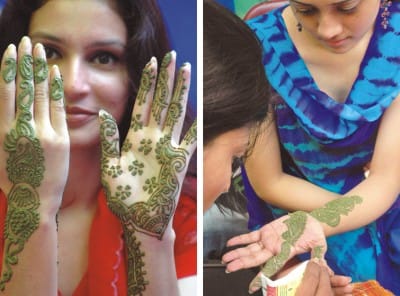
Among the wealth and opulence of the ancient Egyptian and Assyrian royal courts the herb henna reigned supreme along with incense and perfume. The women adorned themselves with its reddish brown tint to complete their beautification. Today, throughout the subcontinent, henna is used as an integral part of embellishment for festivities like weddings and Eid. Women put it on their palms, fingernails and sometimes even up to their elbows. One has known our women to even decorate the upper part of their feet with minute henna designs of rows of dots, lines, and floral designs. Henna is basically plucked leaves that are ground and sometimes mixed with lemon juice, sugar, coffee grains and tea leaves. When crushed between stones it is put on carefully with narrow sticks. The shapes of flowers, leaves, tendrils, paisley patterns, geometrical shapes and starbursts go to make the designs on the hands. Today, in Dhaka, in different shops, just before Eid, young women apply the henna in limitless designs. At home women spend hours making the patterns on the hands. It is not only in Eid that women apply henna to their hands and feet but also during other festivities such as weddings. Then an integral part of decking the bride includes making delicate motifs on the palms of the bride. This is applied amidst music and feasting. The henna is put on amid dancing and music in the bride's house and it is believed that if the henna hue registers well the marriage will be a success. Henna is also an integral part of everyday toilet accessories. Women put it on their long hair to add lustre and camouflage premature graying hair. If they cannot get the tiny green leaves from places such as New Market, they use the powdered form, mixed with water. Today, for the hands, henna is available in cellophane cones in which the basic leaf mixture is combined with other chemicals. Itx is then easy to apply and dries up faster. Some of this is also imported.
|
|

