Civil Society Forum seeks market access for LDCs
Staff Correspondent
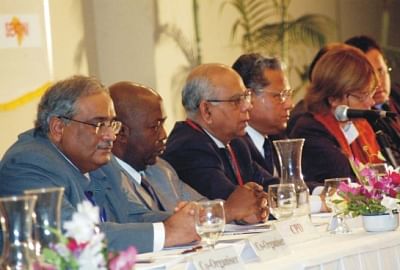
A three-day International Civil Society Forum 2005-- For Advancing LDC Interests in the Sixth WTO Ministerial kicked off in the capital yesterday with a call for providing market access to the LDC products in the developed and developing countries. "There remains much to be done to reverse the continued marginalisation of the least developed countries (LDCs). Our hopes and aspirations have been shattered by a sense of frustration and disappointment," Commerce Minister Altaf Hossain Choudhury said as chief guest at the inaugural session of the forum. Around 50 representatives from 26 countries are participating in the forum organised by the Centre for Policy Dialogue (CPD) at Sheraton Hotel. Pascal Lamy, director general (DG) of the World Trade Organisation (WTO), Dr Supachai Panitchpakti, secretary general of UNCTAD and immediate past DG of the WTO were supposed to attend the forum but they could not due other preoccupations. Messages from them were however read out at the inaugural session. Ambassador Love Mtesa, Zambia's permanent representative at the WTO, read out a message from Zambian Trade Minister Dipak Patel, also spokesperson of the LDC at the WTO. Altaf said the facilities offered by the developed countries under preferential tariff margin are often nullified by the application of non-tariff barriers (NTBs). The NTBs faced by the LDCs should be addressed separately, and on a priority basis, he said. "Exports from LDCs are so insignificant that we fail to understand the difficulties of providing such market access to us." The commerce minister mentioned that the LDCs are predominantly agricultural countries, yet they account for an insignificant fraction of agriculture trade. The LDC products should be exempted from anti-dumping, countervailing and safeguard measures, he thought. In his message, Pascal Lamy said he would pay special attention to the needs of the LDCs. He considers it his duty to rebalance the system by facilitating and promoting the interests of small delegations. "We cannot allow the Hong Kong conference to represent a 'standstill', or worse to bring us backwards. It is our last chance to move this round to a successful conclusion by the end of 2006," he observed. The negotiating process must be all-inclusive and transparent, Lamy said. He would ensure an early circulation of the draft Ministerial Declaration to allow enough time for small delegations to comment. He would create ample opportunity for the LDCs to comment and be part of the process, the DG of the WTO added. Supachai Panitchpakti in his message said civil society has an important responsibility in its advocacy role about the marginalisation of the LDCs in the global economic system. More important perhaps is ensuring the active participation of the LDCs in the negotiations at all stages, he said. There is no substitute for this in articulating and defending one's interests. "But we also need to look beyond trade negotiations and improve the productive capacity in Least Developed Countries," said the UNCTAD secretary general's message, read out by Toufiq Ali, Bangladesh's permanent representative at the WTO. Mahbubur Rahman, chairman of the National Advisory Committee of the LDC Forum 2005, said trade cannot be free unless it is fair. In his introductory speech, Debapriya Bhattacharya, executive director of the CPD, said the road to the Hong Kong Ministerial promises to be both slippery and bumpy. LDCs are not a black hole, as some would like to project them, he said. "What we need is support of the global institutions such as the WTO to help us actualise the potentials about which we are aware, potentials which we are capable of realising." The Hong Kong Ministerial is not the end of the Doha Round, rather it is a mid-term stock taking exercise where the primary task is to agree on the modalities and framework issues of the on-going negotiations, Debapriya noted. He mentioned that the outcome of the first LDC forum on WTO in Dhaka was accorded due recognition at the time of drafting the Dhaka Declaration of the LDC trade ministers, and subsequently played a guiding role in coalescing citizen's support in favour of the collective position of the LDCs in the WTO. Encouraged and inspired by the success of the first LDC forum on WTO, the CPD decided to convene the second forum, Debapriya added. Aftab Alam Khan from Action Aid International of Pakistan said there is much uncertainty about the Hong Kong Ministerial with no clear roadmap for the meet to be held in December. "We fear the wave of divide and rule." Dr Floor Smakman of the EU-LDC Network in the Netherlands said signs of the Hong Kong meet are not altogether positive. The inaugural session was also addressed by Cheikh Tidiane Dieye of Enda Tiers Monde of Senegal, Ricardo Melendez-Ortiz, executive director of International Centre for Trade and Sustainable Development of Switzerland, Anil Prabhakar Tambay, country representative of Oxfam GB of Bangladesh, Pradeep S Mehta, chairman of Advisory Board of South Asia Watch on Trade, Economics and Environmentof Nepal and Nathan Irumba, adviser, Southern and Eastern African Trade Information and Negotiations Institute of Uganda.
|