Formulate modalities of collaboration for poverty cut
Khaleda urges Cirdap governing council
Unb, Dhaka
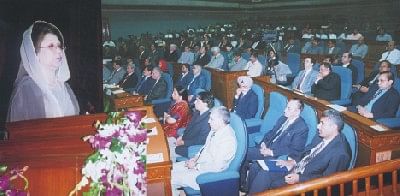
Prime Minister Khaleda Zia yesterday advised the Cirdap governing council to formulate modalities of collaboration between this Asia-Pacific institution and other regional organisations for uplift of the multitudes left out of the glares of urban areas."It is now well established that economic growth is necessary but not adequate for poverty reduction. Perhaps for this reason, poverty still is prevailing as an acute problem in the Asia-Pacific region despite being the fastest-growth region of the world," she told an audience from across the region. The Prime Minister was addressing the inaugural session of the two-day 15th regular meeting of the Governing Council (GC-15) of the Centre on Integrated Rural Development for Asia and the Pacific (Cirdap) at the International Conference Centre (ICC). Bangladesh is hosting a second such ministerial-level meeting of the organisation as earlier in 1993 it had hosted the ninth meeting of the governing council of Cirdap. The Centre was set up in 1979 under the aegis of FAO to assist national programmes, promote regional cooperation and act as a research and training institution in the field of rural development. Cirdap has 14 members -- Afghanistan, Bangladesh, India, Indonesia, Lao PDR, Malaysia, Myanmar, Nepal, Pakistan, the Philippines, Sri Lanka, Thailand, Vietnam and Iran. Cirdap Chairperson (Governing Council-14) and Secretary General of the Ministry of Home Affairs, Indonesia, Progo Nurdjaman, vice-chairperson (GC-14) and Pakistan LGRD Minister Justice (Retd) Abdul Razzaq Thahim, Bangladesh LGRD and Cooperative Minister Abdul Mannan Bhuiyan and Cirdap Director General Dr Durga P Paudyal also addressed the inaugural function. Khaleda said considering the fact that poverty is disproportionately concentrated on the rural areas of the Asia-Pacific region, Cirdap is playing an important role in facilitating coordination of policies and programmes on rural development and poverty alleviation among the member states. She mentioned a new strategic framework developed by Cirdap under the leadership of its director general Dr Durga Prasad Paudyal for adjusting its activities with contemporary realities. She said the GC-15 meeting should thoroughly discuss various aspects of this strategic framework and hoped that the meeting would provide useful guidelines to make Cirdap capable of successfully facing new challenges in the changed scenario. "Assistance of development partners would encourage in implementation of Cirdap vision and mission as well as translate its policies and programmes into reality," Khaleda told the function. The PM noted that five member countries of Saarc, including Bangladesh, are also members of the Cirdap as the mission of both the organisations is to improve the living standards of the peoples of this region. She said a similar context exists in the Asean region. "It is, therefore, heartening to know that Cirdap is attempting to develop institutional linkages with both Saatc and Asean." Listing her government's various successes, polices and programmes, she said Bangladesh has finalised its national strategy for poverty reduction, after in-depth consultation with all stakeholders, with four strategic components. The components are creation of employment opportunities through growth, promotion of integrated rural development, implementation of targeted poverty reduction and social safety-net programmes and increased investment in health, education and nutrition to reduce human poverty. Khaleda said Bangladesh's national targets conform closely with UN Millennium Development Goals and the country has already succeeded in achieving two targets removing gender disparity in primary and secondary schools and ensuring access to safe drinking water. "We are close to attaining two other goals reducing income poverty and under-five mortality,"she apprised the rural development planners from the region. She said Bangladesh's successes in non-formal primary education, oral re-hydration, micro-credit programmes, government-NGO collaboration in the field of rural development, poverty alleviation, social mobilisation and empowerment of women have emerged as models for many other countries of the world.
|