Short Story
English Soup*
Geoffrey C. Ward and Diane R. Ward
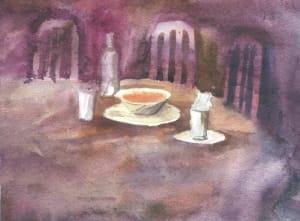
Despite the reassuring respect shown by his family's former subjects, there was little that was truly princely left to the Rao Raja--except for the spectacular fare said to be prepared in his kitchen. And during my first visit to Alwar, our host promised that the royal cooks would outdo themselves.That evening, the rich, pungent smells of Indian cooking filled the parlour as I sipped gingerly at a pre-dinner drink, a family speciality brewed in the palace and said to contain the heads of game birds for added zest. (It was bright orange and tasted simultaneously like rose-water and turpentine.) Scores of stylized portraits of the prince's forebears lined the walls, going all the way back to the common ancestor of all Rajput houses, the sun himself. They all seemed interchangeable to me--each had the same turban, round face, big eyes, flaring moustaches, ropes of pearls--but our host seemed able to tell them apart. A portrait of the radiant founder of his clan hung behind his chair, the family resemblance unmistakable. As the smell of spices filled the room I could hardly believe my luck. I loved Indian food, but in those days it was very difficult for outsiders to obtain it when dining out. The assumption everywhere seemed to be that we could only survive on the blandest of British fare. Whether British rule was ultimately good or bad for India is a matter for scholars to decide. But no sane person who ever ate food prepared in the kitchens of the Raj can have any doubts about Brittania's culinary legacy: it was universally malign. Never in history has so much bad food been served by so many to so few. And English food was not only execrable but inescapable. The sahibs had sailed for home seven years before my family arrived in India, but their death grip on Indian kitchens had not even slightly weakened. Whether you dined at the British-run Hotel Cecil in Old Delhi (where Indians were still discouraged from eating seven years after independence), or at Nedou's in the velvet Kashmir Valley of Gulmarg, or at Laurie's in Agra, where dessert was followed by the Taj Mahal by moonlight, the scene and the meal were the same. There was a big dining room with ceiling fans and dozens of cloth-covered tables, most of them empty. Then as now, Indian dining was labour-intensive. One barefoot bearer in starched pugree and white uniform gravely showed you to your table. There was a different man to pull out each chair. Another poured the water (which, of course, you dared not drink). Still others brought the food and served it, sometimes four at a time padding around the table, each serving something different from a silver tray. When they were not bringing food or clearing plates, the waiters stood in a solemn line against the wall watching as you worked your way through huge courses. You had the sense always that you were silently being measured against the lofty standards of their former masters, and found wanting. First came the soup--transparent, tasteless, brown, and brought to the table in a big shallow bowl to ensure that it was not only without discernible flavour but cold. A pale cube of carrot floated in it all alone. The soup was so universally served in India that my brother has suggested it was all prepared in a single cistern somewhere in the Deccan, then piped simultaneously into the kitchens of every club and hotel and resthouse catering to the foreigners. The subcontinent is the home of mystery, of course, but this theory assumes a brisk efficiency of which India was then, at least, not capable. The savoury followed, a poker chip of toast upon which rested a single warm sardine. Fresh beef was rarely available for the main course for obvious reasons, and water buffalo is an imperfect substitute, so the choice usually came down to mutton (dry and gray and, as often as not, really goat) or roast chicken (pigeon-sized, sinewy and strangled in the kitchen yard that very afternoon). Both came with matching pallid mounds of English 'veg' and nicely browned roast potatoes--the best part of the meal, hands down. A second savoury, often another enshrined sardine, sometimes preceded dessert. Even cooks in very remote outposts could usually manage a good caramel custard, but they too often grew ambitious and proudly offered up instead a big wobbly British 'shape', crenellated with cream and identically sweet and tasteless whether tinted pink or green. The peculiar sucking noise the spoon made as it pulled away a serving of this glistening, unsteady favourite remains with me to this day. At last the Rao Raja's bearer announced that dinner was ready, and we moved into the cavernous dining room and took our places at a long table. A platoon of bearers began filing in through the kitchen door. There must have been twenty steaming dishes. I remember seeing curried partridges and sand grouse and venison. There were hillocks of saffron rice, garnished with raisins and almonds; bowls of golden dal; cauliflower and spinach and potatoes and chickpeas with ginger, and all the pickles and chutneys and hot breads that went with them. My friends dug in. The servants circled wide behind my chair. Then the kitchen door opened again, and the prince paused, a chicken leg halfway to his mouth, and smiled at me. 'Cooked especially for you,' he said, and a beaming servant placed before me another bowl of the universal English soup. *Reprinted from A Matter of Taste: The Penguin Book of Indian Writing on Food, reviewed earlier on this page. Geoffrey C. Ward and Diane R. Ward are historian and journalist respectively.
|
Artwork by Apurba |

