Lest We Forget
Professor Kamaluddin Ahmad
Portrait of a people's scientist and ideal teacher
M Anwar Hossain
The main building of Curzon Hall of Dhaka University founded by Lord Curzon, the then Vice-roy of India had completed its 100 years of founding on 19th of February 2004. The building, which houses the Department of Biochemistry, was also built around the same time. In this red-bricked building of Victorian architectural beauty and heritage Professor Kamaluddin Ahmad, a great son of the soil, established the first full-fledged Biochemistry department of the Sub-continent in 1957. I got admission into this department in 1967 and have ever since got entangled in a triangle -- this building, the department and its lifeline -- Professor Kamal. The reputation of high standard of the Biochemistry department as I heard during my college days was starkly evident to me as soon as I entered the department. In those days, the department boasted highly sophisticated equipment like amino-acid analyser, refrigerated high speed Sorval centrifuge and many other machines in its laboratories. The top students of Dhaka University were doing research in various subjects under the supervision of Kamal Sir. In the labs, work was in progress round the clock, like the world-class universities around the globe. Subject matters were all people-oriented. Some were dealing with cholera; some others trying to increase the nutritional status of food from indigenous ingredients, some were discovering medicines from herbs and plants for deadly diseases, some were working with the deadly fungal poison aflatoxin. Shortly earlier, in 1962-1964, the first ever national nutrition survey had been completed under the leadership of Kamal Sir in the then East Pakistan. The survey revealed the widespread prevalence of various forms of malnutrition among the Bengali population, especially children and mothers. In the 60s, Professor Kamal took a scheme to distribute high-potency vitamin-A capsules to get rid of blindness due to vitamin-A deficiency. Today, night blindness is almost non-existent in the country. Another major crisis was goitre and related illnesses due to iodine deficiency in food. In his department he designed a machine and made arrangements to mix iodine in table salt. With special care he started distributing the iodized salt to pilot-projects in remote corners of the country, especially in the North Bengal. Today goitre is not a public health problem any more in this country. Professor Ganguli comes in my memory. The Indian pioneer scientist of vitamin-A research came to our department on the invitation of Professor Kamal. They were course mates while doing their Ph.D. at the University of Wisconsin in the US just after the Second World War was over. Professor Ganguli mentioned, "Kamal was by far the best amongst us; we were nowhere near his talent". My studies couldn't take root in the department. It was in 1966 when Bangabandhu's 6-point programme took to the roads. Bengali nationalistic movement had intensified. A dream of an armed revolution for the freedom of East Bengal as a Socialist People's Republic was overwhelming. Towards the end of '67, we 15 students of Dhaka University and Engineering University left our studies with the vow to free East Bengal (Bangladesh) and went to Teknaf and the Arakan region of Burma. The venture failed and my elder brother Colonel Abu Taher brought me to Kamal Sir. I didn't keep anything from him. Even after knowing our plans of an armed struggle against Pakistan, he made arrangements to readmit me in his department. Thirst of freedom is always intense in a subjugated land. In 1969, after the mass uprising, I left studies for the second time and went to the deep forests of Bandarban to prepare for an armed revolution. Our endeavour was, however, short lived and my brother again took me to Kamal Sir's residence. Sir was again sympathetic towards this rebellious student of his. And I got another opportunity to continue my studies, this time with a junior batch, by losing a year. 1971 -- on Bangabandhu's call, the whole country flared up with non-cooperation movement. "Surjo Sen" squad was formed under my leadership at Fazlul Haque Hall. We informed Kamal Sir about our plans and got access to the well-stocked chemical store from where we took the necessary chemicals and equipment to make explosives and prepared ourselves for an armed confrontation. Colonel Taher's training of guerrilla warfare and how to make unconventional military weapons had helped us tremendously. On the night of the 25th March, known as the black night, I for the third time left my studies and joined the war against genocide and the war for freedom. Nation got its freedom on the 16th of December, and I returned to my department. In a free country, after completing my honours exams, I left the department once again and went to a remote village of Mymensingh with two of my friends from Geography and Physics departments. This time our aim was to start evening schools and establish modern agriculture among the rural poor. However, I was soon brought back to the department under the persuasion of Kamal Sir and asked to do Masters thesis under his supervision. My research topic was the mystery of a brilliant orange colour in a culture flask. Soon it was found that the colour was due to a carotene pigment (pro-vitamin A) of the yeast Rodotorula. Later in 1982, during my Ph.D. studies at the University of Kyoto, a Japanese Professor present in my seminar mentioned that he too had worked on the carotene of Rodotorula yeast. A research result in the department of Biochemistry under supervision of Kamal Sir in the University of Dhaka done nearly 10 years back surprised the Japanese scientists. On 1st of January 1975, I joined as a lecturer of Biochemistry in our Department. Looking back, I'm astounded to think, that I left studies four times and each time Kamal Sir brought me back. Eventually the reality of becoming a teacher in the department of my dreams came true. It's beyond my imagination. How a teacher can shape the course of a student's life. Teaching life was short-lived for me. In 1975, my brother Colonel Taher led a soldiers' uprising. I was arrested along with my brother and stayed behind the bars for five years. In 1980 after my release from the prison, I joined the department of Biochemistry again as a lecturer. After coming back to my teaching profession, Kamal Sir advised me to do higher studies in a foreign University. With the help of my friend Ashraf, I got the opportunity to do research for my Ph.D. under the supervision of the world-renowned scientist Professor Koji Asada at the University of Kyoto. The wonders and excitement of research experienced during my Masters with Kamal Sir about a decade ago had again bloomed while doing research for my Ph.D. I'm tempted to mention here about an episode of my life around Kamal Sir. In between 1991 and 1994 while doing research as a Visiting Scientist at Purdue University in the US, I came to learn that Kamal Sir was gravely ill in a hospital in East Lancing in Michigan. I called him over telephone. I was told by his attendants that the doctors had lost all hopes of his survival; everybody was waiting for the last moment. Miraculously he got well. More surprising was: after only a few days he wrote me a letter in his own hand from the hospital bed. He mentioned that advanced medical science combined with spiritual science had done the miracle. Endowed with limitless enthusiasm, mental strength and strong determination our Kamal Sir lived for another ten years and actively engaged till the last day of his life in scientific research to alleviate the miseries of common people. During his last years he researched on the mitigation of arsenic poisoning in man. The shocking news of death of my beloved teacher on 4th of July, 2004 reached me when I was in Japan. Memories of the past crowded my mind; I was overwhelmed with extreme pain and sadness. During the tenure of my chairmanship of the department, I on behalf of the Academic Committee and the Coordination and Development Committee, unanimously proposed that Kamal Sir be made Professor Emeritus. University of Dhaka would have been honoured by honouring this extraordinary scientist-teacher. Sadly, we were defeated by our own limitations. I felt honoured to have been able to dedicate two of my lectures to the memory of my teacher in two different Universities of Japan as invitee speaker. We salute you -- Professor Kamaluddin Ahmad, for being a complete ideal teacher and an image of the people's scientist. You will live forever in the hearts of your innumerable students around the world. M. Anwar Hossain, Ph.D. is Professor and ex-Chairman, Department of Biochemistry and Molecular Biology, University of Dhaka.
|
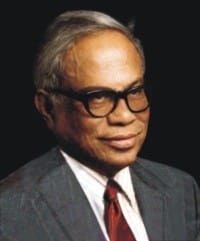
Professor Kamaluddin Ahmad (1921-2004) |

