Women's rights in retreat?
Hameeda Hossain
For over 30 years now, successive governments in Bangladesh, in keeping with constitutional guarantees, have made several principled pronouncements to gender equality and non-discrimination. They may have been persuaded by a strong women's movement, or in deference to aid promises. By ratifying UNCEDAW in 1984, and adopting the Beijing Platform of Action in 1995, Bangladesh made a commitment to introduce policies and laws which would promote equality through affirmative action for women's advancement, where necessary. A 12-point National Policy for the Advancement of Women, prepared in consultation with many women's groups across the country, was enacted in 1997. Under its guidelines, a national plan of action was formulated for each ministry. More recently a draft PRSP paper has also identified gender equality as an indicator of policies for poverty alleviation. Bangladesh has won many plaudits for enabling women's access to opportunities, particularly in education and employment. Just a few weeks ago the World Economic Forum acknowledged that women's enrolment rates were up and maternal mortality rates had gone down. This was welcome news, but there is a general consensus that much more needs to be done to effect changes in women's rights and to enable their participation in decision making. Now, it seems that the government may be reversing its position. A recent publication by the Ministry of Women and Children's Affairs, titled "Jatiyo Nari Unnayan Niti 2004" contains changes made in some of the articles in the 1997 policy document. These proposed changes reverse the earlier commitments made in 1997, and are likely to a backslide in women's rights. These changes are not merely stylistic but could indicate a shift in government thinking. It is strange that the publication does not mention whether they resulted from any consultations with concerned groups, or if they have been presented to the Cabinet. But the publication itself has raised questions as to what influences are at work to bring about a change in the official position. In another instance, the majority party has gone back on its electoral promise of introducing a system for direct elections to women's seats in parliament. This was a commitment made at the time of the elections by both major parties. The Fourteenth Amendment has raised the number of reserved seats to 45, but the mode of election is clearly undemocratic and not a step in women's advancement, as the women members are to be selected in proportion to political parties represented in parliament, and they will not represent a constituency. In yet a third instance, the Ministry of Local Government tried to undercut the power of women's councilors in the Khulna City Corporation by issuing instructions to limit their portfolios, which would make their role unequal to that of male representatives. Implication of Changes in the National Policy for Women 2004
In 1997 the National Policy was formulated in consultation with many women's groups, and had drawn upon the Beijing guidelines. In 2004, amendments to articles 7, 8, 9 and 12 have changed the fundamental language of rights. If the new policy is adopted by the Cabinet, it will deny women rights to property, land and inheritance, it will limit their access to employment opportunities, deprive older women of much needed support, and it will not promote their equal participation in public decision making. The implications of these changes can be compared in the language of the two documents, (relevant changes are indicated in bold). Art 7: NPWA 1997 Ensure women's equal rights in formulation and implementation of economic policy (trade policy, currency policy, tax policy etc.). NPWA 2004 Ensure women's constitutional rights in formulation and implement-tation of economic policy (trade policy, currency policy, tax policy etc.) . NPWA 1997 Provide equal opportunity and partnership/share to women in property, employment, market and business. NPWA 2004 Provide equal opportunity to women in employment, market and business. Art 7.2: NPWA 1997 Provide full and equal opportunity and control over right to land, earned property...inheritance, property, credit, technology, which are essential for women's economic empowerment; and enact necessary new laws to put these rights into practice NPWA 2004 Provide full and equal opportunity and control over earned property...which are essential for women's economic empowerment; and enact necessary new laws to put these rights into practice Art 7.3: NPWA 1997 Take all out initiatives for employment of both educated and illiterate sections of women labor force. NPWA 2004 Take all out initiatives for appropriate employment of both educated and illiterate classes of women. Art 7.4: NPWA 1997 Introduce, expand and develop support services e.g. child care, child daycare centers at workplaces, housing, healthcare and entertainment facilities for elderly, helpless and disabled women for ensuring their participation in economic activities and development process. NPWA 2004 Introduce, expand and develop support services e.g. child care, child daycare centers at workplaces, housing, healthcare and entertainment facilities for helpless and disabled women for ensuring their participation in economic activities and development process. Art 8: NPWA 1997 Motivate non-government institutions including women's organizations to carry out campaign programs for inspiring women's active participation in politics. NPWA 2004 Sentence Deleted NPWA 1997 Take initiative for holding direct election in increased reserved seats in the National Parliament after completion of the current term in 2001. NPWA 2004 Take effective measures including increasing reserved seats to ensure more participation of women in the National Parliament. Art 9: NPWA 1997 Appoint women in high positions including Bangladesh high commissions, university grants commission, planning commission and judiciary. NPWA 2004 Deleted NPWA 1997 Take all out initiatives to appoint women in 30 percent posts at all levels of decision-making including policy-making process to ensure their equal and full participation, based on recommendations of the United Nations Economic and Social Council. NPWA 2004 Take initiatives to gradually increase the existing quota at all levels of decision-making including policy-making process to ensure their more participation, based on recommendations of the United Nations Economic and Social Council. This move into reverse gear has puzzled most women's rights activists, particularly as official rhetoric on gender equality has not changed. The PM in her public speeches never fails to mention her government's role in the advancement of women. And, last July, when submitting Bangladesh's Fifth Report to the UN Committee on Elimination of all forms of Discrimination against Women, the Minister for Women's Affairs committed her government to removing the remaining obstacles to equality, with particular reference to equal rights in marriage, property, citizenship and political participation. The Women's Ministry publication has thus given rise to doubts about the government's position on women's rights. Inequality in Political Representation
A similar ad hoc reversal took place on women's representation in parliament. Even after several ministers had spoken out publicly in support of direct elections to various women's groups, the ruling alliance went back on its electoral commitment to direct elections. The Law Minister in particular was none too fussed at swallowing his words when he introduced the Fourteenth Amendment, according to which 45 seats in addition to 300 general seats are to be reserved for women. But they will be selected by different parties already represented in parliament. This bill is not in the spirit of an affirmative action: it will do little to enhance women's representation of a constituency since they will represent the parliamentary parties and will not be responsible to a constituency. Given their non-representative character, the women who take their seats in parliament under this legislation will not be likely to speak on behalf of women or to seek positive legislation. Unequal Responsibilities for Local Elected
Representatives
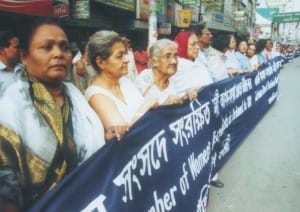
Last year, the Local Government issued instructions to the Khulna City Corporation that women elected to reserved seats would be allocated responsibilities different from those of their male colleagues. This was an obvious move to undermine their role in local government. As it is they had to overcome an inbuilt animosity from their colleagues, so the local government directive has succeeded in further undercutting their effectiveness. These separate moves indicate a tendency to undermine women's capabilities not only in public decision making, but in accessing opportunities as well. The changes in policy, the reversal in its position on women's representation and directions by the Local Government, which are likely to reinforce discrimination, are all part of a package and not a mere oversight. It suggests a fundamental reversal in a commitment to the principle of gender equality which needs to be challenged. Women's Campaign for Justice
In their campaign for justice, women have often turned to the Courts. In the case of the Khulna City Corporation the High Court had indeed given a progressive direction to the administration for allocation of equal responsibilities to women and men councilors. Even if their electoral process is different there is no reason to assume that women do not have equal capabilities. In response to a writ petition filed by several activist women's organizations challenging the constitutionality of the Fourteenth Amendment, the High Court has unfortunately not taken a broad view on the application of Articles 10 and 27 of the Constitution. Under the former, the state is expected to promote the political participation of women, and the latter recognizes the principle of affirmative action to eliminate discrimination. How is the selection of 45 women in a house of 300 supposed to represent equality? The selection process in parliament can be seen as little more than a division of loaves and fishes between different political parties. It is certainly not democratic? The petitioners in their appeal would seek to persuade the Appellate Division to express a better appreciation of the state's constitutional and international commitments, and to indicate a progressive direction towards implementing equality provisions. An observation from the High Court that parties should not deviate from their electoral commitments should not be taken lightly by political parties. Women need to campaign more effectively against an impending backslide. As this is likely to affect all women, on all political sides, the campaign should bring women of different political affiliations together to resist likely regression in women's rights in the personal and public spheres. It calls for a wider sharing with women's groups across the country so that our actions are more concerted whether we address the political decision makers directly or through the courts. Hameeda Hossain is a human rights activist
|