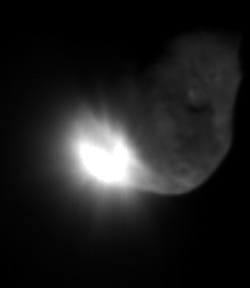
Nasa projectile smashes into comet
AFP, Pasadena
A US space projectile crashed head-on into a comet hurtling through the solar system yesterday in an unprecedented feat of technology that scientists hope will help reveal the secrets of the universe. The probe rammed the heart of the Tempel 1 comet exactly as planned at 0552 GMT, 133 million kilometres (83 million miles) from Earth. "That's awesome! That's awesome!" US flight control officials shouted after the impact was confirmed. "We hit just exactly where we wanted to." A picture sent to Earth by a fly-by probe showed a bright flash of light as the projectile collided with the comet, which is travelling through the solar system at approximately 37,100 kilometres (23,000 miles) per hour and is equal in size to half of Manhattan Island. The copper-laden impactor was beaming back high-resolution pictures of the comet until just a few seconds before the collision. They showed craters, ridges and presumed glaciers on the potato-shaped comet that was discovered in 1867 and named Tempel 1. "We have put a new trail for other people to follow," said Charles Elachi, director of the Jet Propulsion Laboratory, a division of the National Aeronautics and Space Administration that was a key partner in the experiment. The reason scientists are so excited is that comets circling the Sun, which are numbered in billions, are seen as leftovers from a massive cloud of gas and dust that condensed to form the Sun and planets about 4.6 billion years ago. Their geological and chemical structures could thus contain important clues to the nature of the Universe and how it was formed, including Earth. The projectile was fired from a mothership spacecraft, "Deep Impact," that was itself launched from the Kennedy Space Centre in Florida in January. It undertook a 173-day, 431-million-kilometer journey to get close to Tempel 1. After launching the projectile, it then recorded data from the impact. "It's just absolutely stunning," Nasa Associate Administrator Al Diaz told reporters. "To be in a situation where we are here tracking a comet for this period of time and then precisely positioning a spacecraft in a way that creates that environment that is so bright... I am speechless!" He said the success was thanks to broad cooperation between scientists and researchers inside and outside the United States. Although incoming imagery is still to be analysed, the impact was expected to gouge a large crater on the surface of the comet, sending up a cloud of ice, dust and debris that researchers hope will offer valuable information.
|