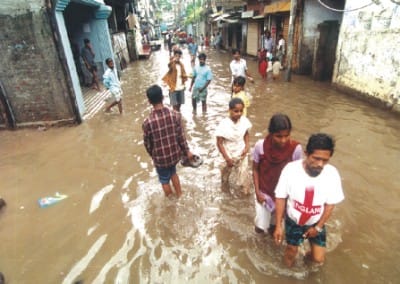
Garbage-choked drains lead to waterlogging
Pinaki Roy
Monsoon rain easily waterlogs Dhaka because its underground drainage system is clogged with garbage, most of the city surface concrete, canals and wetlands filled up, and rivers around the city encroached on and silted. With roughly 120 million inhabitants, the city has grown up in such unplanned way that minimal rainfall induces waterlogging, inundating the city roads and houses, especially on lowlands. "There is no place for the rainwater to go. Canals and wetlands are filled up, the drainage system is clogged, causing the inundation," said Prof Nazrul Islam, an urban expert. "An arrangement should be there to remove the water, as our country is situated in lowlands. Authorities should preserve the wetland inside the city as rainwater reservoirs and work on the drainage system," he added. The storm water drainage system covers 140 square-kilometre area, accounting for only 38 percent of the 360-km DCC (Dhaka City Corporation) area. The coverage consists of 225-km pipe drain, 8-km box culvert, mostly built by filling up the natural canals, and 65-km open channel, sources at the Water and Sewerage Authority (Wasa) said. "Most of these channels are now clogged with garbage and wetlands have been filled up, so floodwaters cannot be drained out easily," said ANH Akhter Hussain, who until recently was managing director of Wasa. Five of the 35 big public canals that used to carry rainwater from the city to the rivers around have been converted to roads and most of the remaining ones to box culverts, while others have been encroached upon by land grabbers. However, Wasa in the last couple of months conducted a drive to restore the canals at the directive of a high-powered expert committee headed by Local Government, Rural Development and Co-operatives Minister Abdul Mannan Bhuiyan. After Sunday's flooding, the government formed another committee to find out the reasons of the inundation. Only a 152-millimeter rainfall on Sunday made the city reel under water and the roads look like rivers. A Met Office climate study says the rate of rainfall has been on the rise, with urban experts sounding the alarm that the city is going to perennially face waterlogging unless authorities do something meaningful. Last year, the capital remained under water for a week in the wake of torrential rainfall last September that broke the 50-year record with a 346-mm rainfall. Besides, floodwaters submerged 40 percent area of the city during the month-long monsoon flooding. After the September rains, nearly 10 lakh people inside the DND (Dhaka- Narayanganj-Demra) embankment were marooned. This year, the DND inhabitants are already marooned with the monsoon only setting in. The experts say around 20 percent open space of a city should be preserved in order to have a healthy habitat, but Dhaka has less than 8 percent open space. "For a low-lying city like Dhaka preserving enough wetlands inside the city as rainwater retention places is a must," said Prof Islam. Recently, an international conference held in Dhaka also suggested preserving floodwater reservoirs -- a technical term for wetlands -- inside the city. But the city authorities cared little about implementing the Dhaka City Master Plan, the long-term city development guidelines. The real estate firms are filling up the lowlands around the city right under the nose of Rajdhani Unnayan Kartripakkha (Rajuk), the city development authorities, according to sources. "We have started a detailed area planning and will finish the job within two years," said Md Nasiruddin, member planning of Rajuk, when asked about the master plan. "But a lot of unplanned structures have already been erected, and it is impossible to knock them down," he added and clarified that development of the storm water drainage system and removal of rainwater from the city are the job of Wasa, not Rajuk. The city has developed and expanded over the years but not the drainage system, said a Wasa official, wishing anonymity. Top Wasa officials blamed the city dwellers and DCC for filling up most of the drainage channels with solid waste. "We cannot expand the drainage facilities due to lack of funds. What we need now is to formulate a drainage policy and carry a study on the system," said a high Wasa official on condition that he not be named.
Related Stories
 PM's promise to solve DND problem remains unfulfilled
A ruling BNP lawmaker yesterday told the Jatiya Sangsad that waterlogging inside the Dhaka-Narayangonj-Demra (DND) embankment has not been solved even after a year of the prime minister's assurance.
Mayor for master plan to solve waterlogging
Mayor of Dhaka Sadeque Hossain Khoka yesterday urged the government to take up a master plan for resolving the nagging waterlogging problem in the capital.
Normal flooding from mid-July, 2 lows likely
Some areas of the country may experience normal flooding in the second half of this month as average rainfall this season is likely to go up by 15-25 percent in addition to rise of water levels in major
|
|
|
|