Poetic language effaces divisions, prose imposes them
Jayeeta Bagchi
April and May 2005 issues
For many educated people discussing 'culture' is an integral part of their lives. However, most find it difficult to keep track of what is happening in the various spheres of 'culture'. If we accept that 'culture' in its most conventional sense is restricted within the boundaries of the middle class, that is, it is nurtured by and caters to the educated urban middle class, then we are the right people to welcome the publication of Kali O Kalam, the monthly magazine covering the arts.If first impressions are lasting ones then Kali O Kalam is fortunate. The covers are undoubtedly chic. The issues begin with write-ups on the cover illustrations, done by Rafiqunnabi, Samarjit Roy Chowdhury and Hashem Khan for the April, May and June volumes respectively. One must admit that literary magazines rarely give so much credit to an illustrator. But then Kali O Kalam's section on art is large and well thought out. The April volume of Kali O Kalam has six articles on fine arts. Novera Ahmed, the sculptor who has disappeared into oblivion but still occupies a major place in the history of Bangladeshi art, is remembered with much enthusiasm by Mehboob Ahmed. Three articles, written by Nahid Akhter, Rashid Amin and Farhana Shifa, on young artists give a very good idea of the recent trends of art in Bangladesh. The fifth article is a tribute to Aminul Islam, a seventy-year-old legendary artist, by Robiul Hussain. Again, the May issue of Kali O Kalam has five articles in its fine arts section, written by Syed Manzurul Islam, Roni Ahmed, Zahid Mustafa, Rashid Amin and Jamal Mustafiz. Mrinal Ghosh's article on 'Globalisation and contemporary Indian visual arts' (Biswayan O Bharater Samakalin Drishyakala ) is erudite and thought-provoking, though I think his categorization of globalization as natural, colonial and pervert/distorted demand more criticism and less passion. I am in no way against passion and value judgment but when one attempts a theoretical discussion passion is usually not the prime requirement. The pages of the fine art section are specially designed and adds colour to the magazine. Speaking of visuals, pages on poetry are also colourful. The list of poets who have contributed in the April issue is long: Abul Hossein, Nayim Gohor, Debarati Mitra, Khaleda Edib Chowdhury, Imrul Chowdhury, Mahbubul-Ul-Karim, Altaf Hossein, Ganesh Basu, Krishan Basu, Suhita Sultana. The poets, coming from both Indian Bengal and Bangladesh, are quite well known but, unfortunately enough, the poems are quite disappointing, at least, in this issue. The cluster of unpublished poems by Abid Azad is a gift to the readers. The heartfelt obituary on Azad written by his close friend Sihab Sarkar is really worth mentioning. Comparitively speaking, the poetry section in the May issue is much better. Veteran poets like Shamsur Rahman, Robiul Hussain, Asad Chowdhury have written along with Bithi Chattopadhyay, Muhammad Samad, Jayanto Joy Chattopadhyay, Monica Rahman, Yusuf Muhammad, Kamrul Hassan, Sangeeta Bandyopadhyay, Tushar Gayen, Tokon Thakur, Debojyoti Mukhopadhyay, Tripti Sandra and Sohrab Pasha. Bithi Chattopadhyay's poem, a grim and eerie imagining of a future Kolkata, is worth a special mention. Tokon Thakur's poem 'The problem language' is also good despite the fact that the word 'Betray'(it has been used for alliteration more than once) has actually betrayed the poem which otherwise could have been great. Articles on poets Nirendranath Chakraborty by Sarat Kumar Mukhopadhyay and Sudhindranath Dutta by Junan Nashit should interest poetry readers. In most cases, neither from their style nor from their use of language is it possible to tell which poet belongs to which half of Bengal. I do not know how to comment on this - whether it is a sign of integrity or a lack of progress! It reminds us that political borders and cultural boundaries do not necessarily coincide. Bangla language, wherever it is written, has the same history and therefore belongs to one cultural domain. In spite of the political division over the last fifty-eight years it seems as though the language of poetry in the two states does not abide by the dictum of a 'Hindu' language versus an 'Islamic' language, though it is admissible that over the years the use of certain words/expressions have become the telltale signs of who belongs to which part of the border. Poetry in its obvious attempt to use a language well beyond everyday usage effaces the distinct marks of differentiation. Fictional prose on the other hand imposes this line of demarcation more strongly. Even the casual reader will easily understand which story is written in which part of Bengal. Nemai Bhattacharya's story Begum, Alauddin Aal Azad's Arora tumi amar priyatama (Arora you are my love), Imtiar Shamim's Projatne nitol neel (Care of endless blue) are all stories dealing basically with a love lost. They are similar in the sense that they are all very male in their essence and as such there is nothing new either in their form or their content to render them striking. Begum in its mission to prove that the religion barrier can never stand in the path of love has lost its verve. Afsar Ahmed's story Sare Barotai Ranna Sesh Hochhe (Cooking is going to end at twelve thirty) is a mundane story of a closed upper-middle class family written, however, in an interesting way. Bhagirath Misra's story Bagh Dekha (Seeing a tiger), in the May issue, is a story about the encounter between an upper-class city slicker and a poor man of Sundarbans. The meek servant's terrible hatred for the satiated master is bound to make one uncomfortable and that is what the story proposes to do. For the short story reader the May issue offers a great story by Sholom Aleichem's story It is a lie! For those who have not been introduced to his writings this is the perfect opener. The translation of the dialogue between Jorge Louis Borges and Victorio Ocampo (in the April issue) demanded a lot of photographs/ pictures which is absent. The translation reads well but without references the reading is next to useless. The May issue offers a good introduction to world literature and theory. In this regard Ali Ahmed's introduction to Saul Bellow and Foyez Alam's long article on Michel Foucault are notable, especially given the scarcity of foreign books in Dhaka. Articles such as these fill a gap. While Akhtaruzzaman Elias's writings deals much with slang, spoken dialects, life, language, dreams and visions of the common, 'ordinary' people, articles on him tend to be written for a class of strangely erudite people in a language which is far from transparent. This lack of lucidity in language is becoming excessively common, on both sides of Bengal, especially when someone is writing, or aspiring to write, a serious critical article in Bangla. This has been sadly encouraged by Bangla departments over the past few decades. This Bangla is not spoken and is so excessively formal and 'difficult' that comprehension and accessibility to ideas are denied. But luckily a long article by Anowar Hossain on Elias's Khoabnaama is an exception to this rule. That people are writing, thinking about, critically trying to appreciate Elias, who died quietly, is something really praiseworthy. The gradual assimilation of Elias into the Bangla discipline will, I think, enrich the language, if not the ideas/ ideals. Rabindranath Tagore and Kazi Nazrul Islam, identified as 'Hindu' and 'Muslim' poets, have now become the national icons representing India and Bangladesh respectively. This is unfortunate considering the fact that none of them would have liked to see their identities restricted to their religious identities and Bangalees divided along these lines. This is something they have fought against all their lives through their works. Yet we keep trying to mark out Rabindranath versus Nazrul, and always attempt to find out the difference that is there between them. Does it have anything to do with the fact that despite all our efforts the poets cannot be contained within such narrow boundaries? Habib Rahman's essay on Rabindranath and Nazrul, in the May issue, does the same I suppose. He has tried to find out what Motaher Hossein Chowdhury had said about Nazrul and Rabindranath, which in its own way is revealing, and my question here is: really, what is it that we are trying to find out? In the same Abdul Mannan Syed gives a long list of poets writing around the time Nazrul was writing, interest in which might be limited to students of Bangla literature. The main article, of the April issue, if I may call it so, is a rethinking on Tagore's Streer Patro (Wife's Letter) by Sanat Kumar Saha. This is actually an answer to another criticism on the same story. However, so much has been written on Tagore and Streer Patro has been so much talked about that it is really difficult to say something new and stimulating on the story. Unlike most other Bangla magazines Kali O Kalam is not shy about reviewing English books. Bangla culture does not mean shutting out the world beyond the Bangla-speaking areas. Also that culture and science are not at loggerheads with each other is another relief. We have to have a basic idea of science in our lives. Mohummad Jafar Iqbal gives us some idea of the theory of relativity in his brief but precise article in the April issue and then follows it with a long article on 'Einstein and the unforgettable Quantum theory' in the May issue . He also writes about Louis Pasteur and the Big Bang in the May and June issues. Kali O Kalam has rich sections on films and theatres as well. Dipankar Chanda reviews the play Tirthankar in the April issue and Shafi Ahmed reviews Mukti in the May issue. Kali O Kalam's concern over gender is also very refreshing. The letters to the magazine reveals that every issue deals with gender in at least one of its section. The film and fine arts section in the April issue talks about women's perspectives and perspectives on women in visual media. June 2005
While I was going through the April and May volumes of Kali O Kalam the editor of this page arrived on my doorstep with the June volume. There was no option but to read all the three volumes rapidly. It was a great pleasure, no doubt. Selina Hossain's Bhabmurti (Image) is a violent, unnerving story, about a middle-class matriarch/housewife who wants to control everything and everyone in her house. In her anger that she cannot do so she kills a cat. I, at least, have not come across such a character in Bangla literature, at least not one who is a woman. It makes for compelling reading. Amar Mitra's story Dudher Meye is a clichéd tale about a middle-class woman's desires to be a mother, as is Shyamal Mojumdar's Sritamar Prithibi(The world of Sritama). Manabendra Bandyopadhyay's article on Annada Shankar Ray deserves special attention as it beautifully weaves Ray's structure of rhymes, and its connection with the author's own reaction to the division of Bengal. Ali Anowar's reading of Bankim Chandra Chattopadhyay in a post-colonial perspective in Bengal is very pertinent today especially as he explicates Bankim's understanding of his times. Kabir Chowdhury's essay on the life and works of Nadine Gordimer is informative. Foyezul Azim's reading of Zainul Abedin's paintings would undoubtedly throw new light on the artist we think we know so well. As usual, the fine arts section of this issue too is of high-quality. Kali O Kalam's variety of sections is intriguingly ambitious, though I have to confess that it creates problems for a reviewer. One must congratulate the editor/editorial board for wanting to cover such a wide range of subjects. Kali O Kalam, I firmly believe, will stay alive for a long time not merely because it has an experienced editorial board or because it is brought out by a reputed house of publishers but because it offers a substantial reading material for Bangla readers. Jayeeta Bagchi is a freelance writer/teacher.<.i>
|
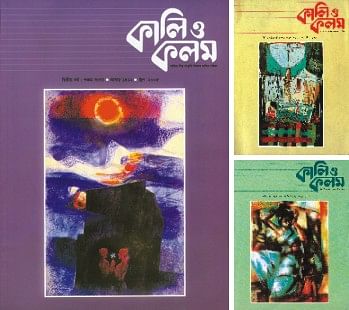
Kali O Kalam, sahitya shilpa shongskriti bishoyok mashik potrika, editor Abul Hasnat, published by Abul Khair/Ice Media Limited, Dhaka |

