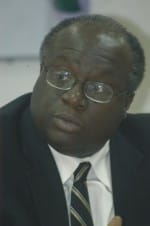
Interview with Harry K Thomas
'We would like Bangladesh to live by the ideals of liberation war'
US Ambassador Harry K. Thomas is returning to Washington on July 2 to take up the position of Executive Director of the US State Department, bringing to an end his two year tenure here in Dhaka. The Daily Star's Zafar Sobhan met with him to discuss his time here in Bangladesh and his views on US-Bangladesh relations.The Daily Star (DS): Recently you were quoted as saying "People may look for an alternative if the major political parties do not work together on issues of national interest and that will not be good for the country." Would you care to elaborate on what you were suggesting?
Harry K Thomas (HKT): People are pretty bright. I think they can figure it out. DS: But do you have any creative ideas about how we can solve the problem of political gridlock here?
HKT: The problem is simple to see. Finding a solution is not so easy. I don't know, to tell you the truth. President Clinton came here and got the prime minister and the leader of the opposition talking. Maybe we need President Bush to come here now (laughs). Maybe that's what it would take. DS: The US and you personally are obviously unhappy about any number of domestic issuesextra-judicial killings, the persecution of Ahmadiyyas, political terrorism, etcbut is there anything the US can or in your opinion should do about these? Basically I am asking what you see the appropriate US role to be here.
HKT: No one likes to be bullied. No one likes to be threatened. We try to persuade. The government. The opposition. Everyone. We would like Bangladesh to live by the ideals of your liberation war and your excellent constitution. We care about human rights. We care about trade. The economic relationship. That's what we try to focus on. DS: Is there anything you would like the US to do more vis a vis Bangladesh? Any specific initiative you would like to see implemented?
HKT: I don't think we need to do more, frankly. I think we need to do a better job of publicising what we do already. $100 million has been distributed this year through USAID. We have 70 peace corps volunteers here, soon to be 150. We have the American Corner library in Chittagong and Sylhet. Training centres for peacekeepers. Bangladesh gets more diversity visas than any other country in the world. For the past three years. People don't know this. I mean, we've been here since 1954 doing flood relief. We're the number one export market. What I would like to see more of are cultural exchange programmes. And I think we will be seeing more in future. We have started to screen films at the American Centre again. That's the type of thing I'd like to see more of. In fact, with air service from India getting better, cultural exchanges will be easier. One problem we've had in the past is getting people here in a timely fashion. I would love to see a renewal of the days when people like Muhammad Ali and Duke Ellington traveled the world as ambassadors for peace. That's something we need to do more of here in Bangladesh. DS: What would you like to see from us?
HKT: We are pleased with recent steps. The signing of the UN anti-terror convention. The arrest of Ghalib. Stamping out of violence against NGOs. More ministers have started coming to the US on a regular basis. We welcome this. Not just ministers. BGMEA too. This is what is needed. We are happy to host people of influence, whoever they might be. DS: You have served in New Delhi and were once the Director for South Asia of the National Security Council. What is your view of Indo-Bangladesh relations? Has your view changed since coming here?
HKT: I am hopeful that the relationship is getting better. I am very encouraged that the Saarc summit will finally be held. I hope that Safta can be implemented shortly. Recently there have been what seem to me to be very positive discussions between the two sides on a number of issues and a cooling down of rhetoric. Neighbours have to live together and get along. There is no alternative. DS: There is a difference of opinion between Dhaka and New Delhi rigt now on a number of issues of fact. For instance, on the presence of insurgent camps within our borders. The US has its own intelligence on the matter. Who is right?
HKT: I'm not going to comment on security matters. DS: Changing gears, do you think the Bush administration has made any missteps in its war on terror and drive for democratisation around the world? What steps can be taken to make these more successful?
HKT: The problem is that small groups, certain elements have violated human rights and there is the belief that we are anti-Muslim. Nothing could be further from the truth. I hope that a stable government in Afghanistan and Iraq will demonstrate this. Iraq is now a democracy. The Iraqis want to vote. Saddam's reign of terror is over. What we need to do for US credibility is to make Iraq and Afghanistan work. This is what will change perceptions. In the context of Bangladesh, it is our programmes here that will change perceptions. Scholarship programmes for kids, which I hope we can expand. We are now exposing our people to Bangladesh more. One quarter speak Bangla. We have to show that we really do care and we have to be above reproach. DS: Do you think Abu Ghraib and Guantanamo should be closed down?
HKT: The Vice-president has said they won't be. DS: But in the interests of the US image?
HKT: Look, we have to live up to our ideals. No question about it. Those guilty of human rights violations need to be charged and prosecuted and sentenced. But let me say one thing about the US image in the world. You never see visa lines to come to the US get any shorter. Seems like the old saying: "Yankee go home, but take me with you." DS: Thank you very much, Mr. Ambassador. I wish you well in your new career and hope to see you again down the line.
HKT: Thank you and good luck to you as well.
|