Celluloid
Hajaar Bocchor Dhorey: The saga continues...
Karim Waheed
Hajaar Bocchor Dhorey, a novel penned by the immensely talented writer-director Zahir Raihan, has been an indivisible part of the Bangalee life for decades. His wife, actress turned director, Kohinoor Akhtar Shuchanda had always wanted to bring this immortal literary work to life on celluloid and with the help of government funding she has succeeded in attaining her goal. At the film's recent premier show held at Star Cineplex movie theatre, Shuchanda said, "Hajaar Bocchor Dhorey is my homage to my husband, Zahir Raihan. I don't believe a man of his stature has been truly evaluated yet. I hope this film will make a place in the hearts of many for years to come." The event was presided over by renowned filmmaker Gazi Mazharul Anwar and the chief guest was M Shamsul Islam, minister of information. Other distinguished guests at the show were Moudud Ahmed, minister of law, justice and parliamentary affairs, Najmul Huda, minister of communications, Dr Abdul Moyeen Khan, minister of science and information communication technology, Barkatullah Bulu, advisor, ministry of commerce, Major General (Retired) Anwarul Kabir Talukdar, state minister for finance and planning, Selima Rahman, state minister for cultural affairs, Sadek Hossain Khoka, Mayor of Dhaka City Corporation and Mosaddek Ali, member of parliament. Hajaar Bocchor Dhorey delineates the simple rural lifestyle, often intertwined with superstitions through generations. The era Zahir Raihan had portrayed in the novel, saw women being used as mere commodities. In the male-chauvinistic village communities, women were not allowed to decide their own fate and polygyny (having multiple wives at a time) was widely practiced. Not only did the women have to struggle with the hostile social environment created my men, they often found themselves at the receiving end of injustice done by their own kind -- other women. Although their plight has changed through decades and women now enjoy their hard-earned rights, people can still relate to Hajaar Bocchor Dhorey for its timeless appeal. The movie starts with Maqbul's ancestors coming across a beautiful lake created by floodwaters. They occupy the fertile land adjoining the lake. Years later, Maqbul is seen living with extended family, three wives and a daughter. Maqbul who is an aged man now, has little in common with his third wife -- the vivacious, naive, 'just past adolescence' Tuni. She is smitten by Maqbul's much younger brother Mantumia and the feeling seems to be mutual. They enjoy each other's playfulness while fishing at wee hours of the night, or picking water-lilies to make leis. Mantumia tells Tuni how angels created the lake called Pareer Dighi --demonstrating how myths are born. However, when the family pushes Mantumia to marry Ambia, a helpless girl who has just lost her whole family to the epidemic cholera, the naive Tuni turns into a conniving vixen. She convinces Maqbul that by marrying Ambia he would not only inherit her property and boat, but enjoy Ambia's services as well. Maqbul, being senile and avaricious as he is, decides to go with Tuni's plan, ignoring the other members of the family and divorces two of his wives who dare to oppose him. The film ends with an older Mantumia enjoying punthipaath (fable recital) with his offspring with a distinct sense of déjà vu of his youth. Shuchanda has pragmatically narrated the story of generations and the authentic beauty of our country has been captured in the movie. The unspoiled greenery, refreshing yellows of the mustard fields, the scenic lakes and ponds, ornate with water-lilies and serpentine narrow village paths, soothe urban eyes. The songs, particularly the a cappella numbers don't seem forced. Asha cchilo money money, a melancholy folk ballad, reflects the emotions of two seperated lovers. Riaz as Mantumia does justice to the character. Veteran actor ATM Shamsuzzaman does not disappoint the audience as usual. Newcomers Shashi and Shahnoor evince talent. Though Shahnoor as Ambia seems to overact at times, Shashi as Tuni is natural and credible. Her portrayal of a vivacious village belle reminds one of a young Kabori. Late actress Najma Anwar as Chachi is the voice of conscience and makes one realise the irreparable loss caused by her untimely demise. The film will be released in Balaka and Star Cineplex on July 8 and the world premier will be held on ntv. It's a 'must see' for movie aficionados who support the movement against the current trend of vulgarity.
|
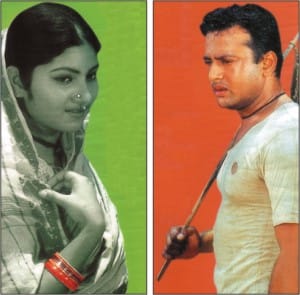
Shashi as Tuni & Riaz as Mantumia |

