Village potters go global
A backwater neighbourhood churns tiles for European markets
Our Correspondent, Satkhira
Kumar Para, meaning potters' neighbourhood, stands thousands of miles from Europe. But the thriving village of Murarikati in Kalaroa upazila has recently come to be known as 'Italy Nagar'. Every year, thousands of tiles produced here find their way to Italy and other European destinations, thanks to a recent renaissance of traditional pottery that is dramatically transforming the area. Just a few years ago, potters in the area feared they were on the brink of extinction. Demand for their traditional crafts- earthenwares like pots, pitchers and other utensils - slumped, sending a devastating ripple through the local economy. "The potters in this ancient profession have been having a hard time for years," said Bimal Pal of Kumar Para of Murarikati village. "The demand for clay utensils has diminished over time due to the availability of cheap, handy alternatives made of aluminium or glass or plastic. The trade has also been hurt by the migration to India by many of the potters community." Those who remained, however, have lived to see their village blossom into an unlikely success story. Rafeli, an Italian national, may not have realised he would help launch a cultural revolution here. In fact, initially it seemed like his coming was a regrettable mistake. Rafeli set up a tile factory in Narayanganj in 2002, dreaming of producing exportable tiles for Italy. But he soon closed the factory down and returned home, sad to discover the quality of clay was not what he hoped. The real story, however, began after Rafeli left. His dream remained alive, pursued by Ruhul Amin, the Bangladeshi manager of the short-lived Narayanganj factory. Undaunted and untiring, Amin kept in constant contact with his Italian friend, visiting various parts of the country in search of quality clay for exportable tiles. He finally struck gold in Murarikati in 2003, finding standard clay for high quality tile. Soon he was back on the phone with Rafeli, convincing him to return to set up a factory at Kumar Para of Murarikati village. Their new tile venture, "Karra Export-Import Private Company Limited" first exported tiles to Italy in 2003. Demand has grown exponentially since then and continues to rise. As of March this year, at least 70 containers of tiles were shipped to Italy. The boom has spawned an ever-growing cottage industry of traditional pottery and tiles. Some 3,000 potters, encouraged by the renaissance, have set up approximately 50 factories here. The colourful tiles they produce are exhibited at show rooms in Italy, and eventually find their way to floors, roofs and walls in homes throughout Europe. Rafeli, meanwhile, manages to visit almost every year. Many of the potters work collectively in families, including husbands and wives, sons and daughters. After receiving orders from the Italian buyers, the Italian company sends orders to the Karra company. The potters then set to work making the tiles, painting them with waterproof colours as per demands. The finished tiles are then taken by truck to the Mongla port, where they are packed in cartons and sent to Italy by ship. On a recent visit to Murarikati Kumar Para, Jagabandhu Pal and his wife Debala Pal were busy making tiles in their own factory. They explained that tile making is a complicated process that involves lifting the clay and then kneading it with water to make paste. The tiles are then fixed in a casting matrix, before being dried in the sun and baked. Jagabandhu described that the tile product boom has helped revive a once dying way of life. "Some families have migrated to India. Some changed their profession. Ten years ago, I also thought of becoming a rickshaw puller. But eventually I could not leave my ancestral occupation like many of my community. We are artisans. Art is in my blood. It's not easy to leave it." Along with the tiles, the potters also produce smaller numbers of traditional products like pots, pitchers and other utensils. The potters say they owe their rebirth to Rafeli and Ruhul Amin of village Rahmatpur in Babuganj upazila of Barisal district, who worked relentlessly to facilitate the export of tiles to European countries. "Thanks to a rise in the making of exportable tiles and exporting to European countries by an Italian national and a Bangladeshi who inspired us, the making of tiles here has reinvigorated our occupation..." said Dulal Pal. The newfound prosperity has erased frustration and stagnancy for many of the potters, particularly the middle-aged ones best able to note the difference. "Good days are back again," said a giggling Jagabandhu Pal, standing in front of his tile factory in Murarikati Kumar Para. As the demand for pottery and tiles has flourished in Europe, so too has the livelihood of the potters. "By making exportable tiles, they are now able to maintain their families and are dreaming the dream of living," said Swapan Pal of the area. Debala Pal, Jagabandhu's wife, agreed. "Our second daughter is now going to school," she said, recalling they could not send their first son to school due to poverty in the past. "Children from other families also go to school now," she added. Today, potters in the village see their success as a tale of inspiration, the culmination of perseverance and dedication to their craft. "We have done it with our own merit and labour. We required government patronisation and soft loans so that we can run our factory to make exportable tiles as it bringing foreign currency. Tile making with clay and their export abroad employs thousands of potters who were about to give up their traditional profession," said Radha Rani Pal.
How to make tiles?
Different processes are there for making tiles. The first step is clay lifting. Then comes kneading clay with water and then making tiles in a fixed casting matrix. After that, those are dried in the sun and burnt in fire. Finally, they are ready to be supplied as finished products. How the tiles are ported and exported?
In Italy, the tiles are exhibited in showrooms to lure potential buyers. The buyers then place orders with the Italian companies who in turn send orders to the Karra Company at Murarikati, asking it to send tiles to Italy. The company takes the tiles to the Mongla Port by road. The tiles get packed up there in cartons and shipped to Italy. This way the clay tiles made at Murarikati are used in tiling floors, roofs and walls of Italian mansions.
|
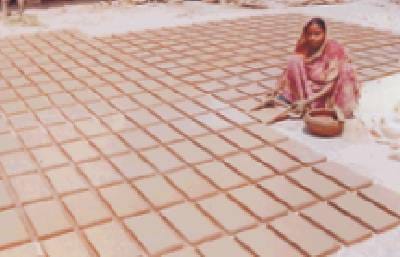
A woman lays tiles for drying at Kumar Para of Kalaroa upazila in Satkhira. Thousands of tiles produced here are exported every year to Italy and other European destinations. PHOTO: STAR |

