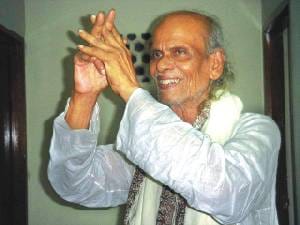
Life under the shadow of music
In conversation with Shah Abdul Karim
Afsar Ahmed
The remix version of the songs: Maya Lagaisey or Gari choley nah choley narey are immensely popular nowadays among the youth. As the urban music lovers are more inclined towards modern songs, we often fail to recognise the original singers. The credit for these timeless songs must go to legendary singer and composer Shah Abdul Karim. Karim's unique presence in the world of the Baul school of thought gives him the title Baul Samrat. He has taken Baul music to such heights that documentary filmmaker Shakur Majid is making a documentary on him titled Bhatir Manush. Recently, he came to receive the Life Time Achievement Award at the Meril Prothom Alo Award 2004 and talked to The Daily Star. Karim, with no musical background in his family, was deeply engrossed in music from his childhood. The river Kalni near Karim's village created a ripple in the young boy's heart. In his words, "The waves of Kalni chased me and told me to get my ektara and sing." His urge for music and attraction to the bohemian life never allowed him to go in for conventional schooling. The appeal of the songs like Ashi boley gelo bondhu ailo na, Ami kulhara kalankini, Mon kandey pran kandey kandey amar heeya, Kemoney bhulibo ami bachi na tarey chhara, Tomar kunja shajaogo aaj amar prannath, Ami tomar kaler gari and many others exemplify Abdul Karim's love for his wife Aftabunnesa and the life sketch of the people of the low and swampy land (bhati anchal). In the remix culture, many artistes are using his songs. Although he feels good about this phenomenon, he is dismayed by the distortion of the songs' lyrics and tune. Karim is far from happy about the present situation of the Bauls too. As he says, "Although there are many look alike Bauls, there are very few authentic Bauls." In his late 80s, this famed singer's memory often fails him. He however, claimed that he was born in February 1916 and in Bangla in the month of Phalgun, 1322 at the Ujaldhan village of Sunamganj. In fact, he composed a song Phagun masher prothom mongolbar, Ma bolechhen jonmo amar (I was born in the first Tuesday of Phalgun as told by my mother). Teenager Karim took part in the regular ashor of the folk songs, especially the programmes rendering the songs of Gazi-Kalu during monsoon that captivated the villagers. "Here I sang with the eminent singers and was immensely inspired by them," reminisces Karim. The pristine rural tunes that had already attracted him eventually motivated him to conduct research on folk music. Karim took his first lesson from Baul Kamar Uddin Ustad from the village Ujandhal and began performing regularly in his troupe. Later, Karim received guidance from famous mystic singer Ustad Rashid Uddin. By this time he had earned credentials in this genre of music and earned the sobriquet of Baul Samrat. Spiritualism is the focal point of Baul music. Karim is a follower of Shah Ibrahim Mastan and Maula Baksh from Sreepur. Karim took lessons on different genres including shariyat, marefat, nabuyat and belayat and songs of Lalon Shah, Panju Shah, Duddu Shah, Hazrat Mansur and other prominent Baul fakirs. During the insurrection against the British, the teenaged Karim also composed several songs. "Almost every evening there were competitions called Kobijuddha by the folksingers. It so happened that I never sang the same song twice and as a result many songs were lost over time," says Karim. In 1964 and 1985 he went to England and performed in several concerts. But unfortunately there is not a single audio cassette or CD of this great maestro. Only a few are still available at the Sylhet Betar, which should be revived, informs his son Shah Noor Jalal. He has also written six books on music comprising his precious lyrics. However, the book Aftab Sangeet is lost and others are also in vulnerable condition. Due to old age complications Karim was unable to perform for a year. A recipient of the prestigious Ekushey Padak in 2001, he never gets the assistantship from the government as a needy artiste, says Jalal. "There is no land of my own to bury me," says an impoverished Baul Samrat. Named after him, Abdul Karim Sangeetaloy is the yet to be fulfilled dream project of this legend. In his own words, "I don't want any thing except my dream fulfilled. Aar kichhu chaina gaan chhara gaan gaiya monrey bujhai (I don't want anything but songs)."
|