Satyajit Ray's 84th Birth Anniversary
Remembering the magician behind the camera
Afsar Ahmed
Satyajit Ray, the legendary filmmaker, is known for his unique approach to cinema. Though he made his films in Bangla, his works are of universal interest and reveal a remarkable humanism, elaborate observation and subtle handling of characters and situations. On the occasion of this master story teller's 84th birth anniversary, the Department of Theatre and Music, Dhaka University in association with Bangladesh-Bharat Sampriti Parishad, Association of Bangladeshis who studied in India (ABSI) and the High Commission of India organised a programme on May 2 at Natmandal. The programme started with eminent professor Dr Anisuzzaman placing wreaths on Satyajit's portrait. Remembering this great director, Anisuzzaman said, "The cinema of Satyajit Ray is a rare blend of intellect and emotions. He is controlled, precise, meticulous, and yet, evokes a deep emotional response from the audience." He added that, "In addition to filmmaking, Ray was a composer, a writer and a graphic designer. He even designed a new typeface." Dr Rajeev Humayun, president of ABSI said, "There was a time when we used to talk for hours on Ray's films during the 1960s and 1970s. The four generations of the Ray family, from Upendra to today's Sandeep, are dedicated to enriching Bangla literature and culture." A nostalgic children littérateur, Ali Imam reminisced on his 10-minute encounter with Satyajit in 1986 and said, "Satyajit utilised every second of his life. Apart from writing and making films he has earned a niche in typography and graphics art. His commendable touch is visible in his portrayal of children and old people in his cinema and his detailed sketches of costume, set design and planning of screenplays." Dr Shoumitra Shekhor presented a keynote address on "Satyajit Ray's literature for children" and said, "Besides the family tradition of writing, Satyajit has his unique style which generates pure entertainment. His tremendously intelligent detective Feluda or the genius scientist Professor Shanku and many other characters are precious contributions to Bangla literature. In 1961, he revived and continued to publish the Bangla children's magazine Sandesh, which was funded by his grandfather Upendrakishore Ray." Deputy High Commissioner of India in Bangladesh Sharbajit Chakravarty, poet Sabir Ahmed Chowdhury, Dr Neem Chandra Bhoumik also spoke at the programme while Dr Mridul Kanti Chakravarty, Acting Chairman of Department of Theatre and Music, Dhaka University presided over the programme. The second part of the programme exemplified the music sense of this great director in his films and the rendition of songs by the student of the Department of Theatre and Music. "In the beginning of his career, Ray worked with some of the greatest music maestros of Indian classical music; Pandit Ravi Shankar for the Apu Trilogy and Parash Pathar (1958), Ustad Vilayat Khan for Jalsaghar (1958) and Ali Akbar Khan for Devi (1960). Since Teen Kanya (1961), he began composing the music for his films," said Mridul Kanti. Mridul continued, "He would start working on music in the very early stages of a production - sometimes as early as in the script stage. He would keep notes of the music ideas as they evolved. He meticulously wrote the scores in folk, raga and western notation depending on musicians and the screenplay." Beginning with the song Aha ki anondo akashey batashey from the movie Gupi Gain Bagha Bain the singers also performed the songs Maharaja tomarey selam(Gupi Gain Bagha Bain) and Paye pori bagh mama (Hirok Rajar Deshey) to the delight of the audience. The two Tagore songs from the movie Charulata, Ami chinigo chini tomarey by the students and Phuley phuley dholey dholey by Lilly Islam were entertaining. The last performance of the programme was by the guest artiste from India, Sharathi Chatterjee with Prasun Chatterjee on tabla performing raga Puria Dhanesri.
|
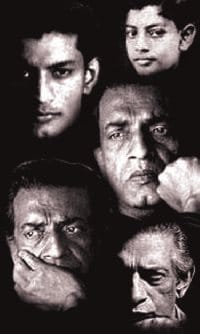
Ray in different phases of his life |

