Aurora passes away
Pallab Bhattacharya, New Delhi
Indian army legend Lt Gen Jagjit Singh Aurora, who oversaw the surrender of about 93,000 Pakistani troops in Dhaka in 1971, died in New Delhi yesterday at 89.Aurora, who had been ailing for sometime, died of heart failure in sleep at a private hospital. Born on February 13, 1917 in Kalagujran village of Jhelum district, now in Pakistan, Aurora was commissioned into the Indian Army in the first battalion of the 2nd Punjab Regiment in 1939. His participating in action came during the World War II in Burma. In the 1948 Kashmir operations, he led the same battalion in Pir Kalewa region of Rajouri district. Later, he commanded a brigade in the same sector. He assumed the charge of deputy chief of army staff in June 1966 with the rank of Lieutenant General, a post which he held till April 1967. Then he served as the general officer commanding (GOC) of Eastern Sector corps headquarters from 1969 to 1973. Known for his ice-cool temperament in the face of the most adverse situations on the war front, it was under his leadership that the Indian forces carried out the lightning strike in the then East Pakistan, which ultimately led to the liberation of Bangladesh with the fall of Pakistani troops. Gen Aurora presided over the historic surrender by Pakistani troops under Gen AAK Niazi in Dhaka on December 16, 1971. The photograph showing Niazi signing the surrender deed has become an abiding symbol of an epoch-making event in world history that saw the birth of Bangladesh as an independent nation. When Niazi died last year, Aurora remembered him as a man of few words. "I am sad. I came to know him first when we were together at a college in Quetta and after that I met him during the Bangladesh war. He has been a quiet chap," Aurora said. Besides 1971, he also took part in India's first war with Pakistan over disputed Kashmir in 1947. During his retirement, Aurora championed India's Sikh minority cause. He opposed the security forces' "Operation Blue Star" in the Golden Temple, the holiest shrine of Sikhs, in the northern city of Amritsar in 1984 to flush out Sikh militants and took up the cause of victims in the anti-Sikh riots following the assassination of Indira Gandhi. Describing Lt Gen Aurora as the "principal architect" of India's victory in the Bangladesh war, Defence Minister Pranab Mukherjee said he would be remembered as a great war-strategist and a great son of India. Decorated with Padma Bhushan, a civilian award of the Indian government, and Param Vishist Seva Medal of the Indian army, Aurora was elected to Rajya Sabha, the upper House of Indian Parliament, in 1986, as a candidate of Shiromani Akali Dal. Aurora is survived by a son and a daughter. Gen Aurora's funeral will take place tomorrow with full military honour at the Brar Square in Delhi Cantonment.
|
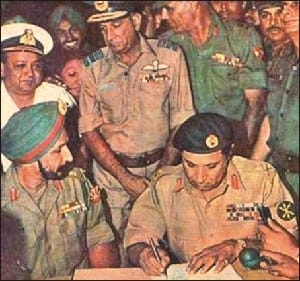
Lt Gen Jagjit Singh Aurora, left, then chief of Bangladesh-India joint command, looks on as Lt Gen AAK Niazi, commander of Pakistan occupation forces, signs the surrender treaty on December 16, 1971 at Race Course, Dhaka. PHOTO: Star File Photo |

