Tall talks, but no action to check land grabbing
Shakhawat Liton
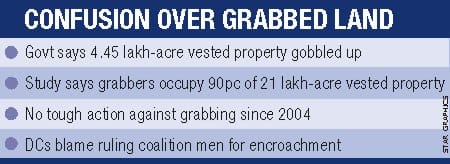
In one and a half years since identifying land grabbing as a national concern the government has not initiated any drive but on paper only to recover at least 20 lakh acres of encroached land.In October 2003, a meeting of secretaries chaired by Prime Minister Khaleda Zia identified land grabbing as a major issue of concern and formed a secretarial committee to address it. The committee came up with a comprehensive report in three months in which it made a set of recommendations, including legal amendments to provide for sterner penalty to stem land grabbing. But nothing concrete has happened since then; the administration has just been sitting on the recommendations. And, while the government failed to act out its own agenda, grabbers continued gobbling up forest and Khas land and Waqf and vested property across the country. It also appears the government even knows not exactly how much land and property it owns or wards. It also has no specific figures on how much of that land and property it actually controls and how much it has lost to grabbers, encroachers and squatters. A persistent lack of co-ordination among the government, municipal and other organisations and agencies makes it difficult for the land ministry to detect and recover the grabbed lands, officials said. However, the scattered data available with various government bodies and agencies suggest the area of public land now in grabbers' hand is no less than 20 lakh acres, while according to some studies, it is much more, over 30 lakh acres. Incidence of land grabbing is higher in the metropolises than elsewhere, obviously due to higher level of price and value. In Dhaka and its environs, grabbers actually far outweigh the government in terms of possession of public land. Against the 4 lakh acres of public land they occupy, the government controls only 1 lakh acres, the parliamentary standing committee on land ministry said on December 28, 2003 quoting reports of the district administrations. The committee also received a list of business houses and elite including cabinet members and lawmakers in possession of public land. And they have continued to be in possession of their ill-gotten property for the last 15 months, although the PM and her cabinet colleagues repeatedly sounded tough against this crime. The latest whistle blowing came from the prime minister on April 9 last when at a conference of deputy commissioners (DCs) she once again termed the issue a national problem and asked the DCs to initiate stern actions against the perpetrators. A number of DCs attending the conference blamed ruling coalition leaders for grabbing public lands in their areas. They also emphasised the need to beef up local-level land offices with more logistic facilities and manpower. CHRONOLOGY OF INACTION
"Tougher actions have to be taken against law-breakers, those who interfere in governance, tax and loan defaulters, grabbers of land and property, hoodlums and criminals without any fear," the prime minister told government secretaries at a meeting on October 4, 2003. A high-powered secretarial committee headed by Cabinet Secretary Sa'adat Hussain was formed in that meeting on land recovery. The committee in its report in January 2004 identified dishonest real estate companies, shrimp farmers, industry owners and politicians as well as gangs of frauds, Mafioso, forest bandits, pirates and local touts among the major land grabbers. A number of trusts, foundations and social organisations are also engaged in the malpractice, the report said. The committee recommended some major changes to the laws concerned, including the Criminal Procedure Code (CrPC) and the Government and Local Authority Lands and Buildings (Recovery of Possession) Ordinance, 1970 to check land grabbing. The committee viewed articles 417, 447 and 448 of the CrPC that deal with punishment to land grabbers as outdated and called for making the punitive provisions tougher. It observed that although the ordinance has provisions to punish encroachers, it lacks proper guidelines and bite to prevent land grabbing and recover encroached lands. It proposed to increase the duration of imprisonment for land and property grabbing by individuals from two years to five and fine from Tk 1,000 to Tk 50,000. In case of land or building grabbed in an orchestrated way by organised gangs, the committee recommended jail terms of 5 to 14 years along with a fine of Tk 10 lakh. It also recommended introducing non-bailable and non-settleable clauses in Section 7(1) of the land and building recovery ordinance and amendments to Section 9(1), giving trial courts the power to fix and realise damages from the offenders and give them to the affected party. But in more than 15 months since January last year, authorities have done nothing about the recommendations except for dishing out ear-soothing words. KHAS LAND
It has become a subject of controversy as to how much Khas land the country has and how much has been gobbled up. The land ministry, the parliamentary standing committee on land ministry and study reports cite different figures. There is only over 6 lakh acres of Khas land in the country, former land minister M Shamsul Islam told the budget session of Jatiya Sangsad (JS) in 2003. Contradicting him, the parliamentary standing committee on land ministry quoting reports available from 53 districts last year said the government has 10 lakh acres of Khas land. The same JS body at a later meeting said the total Khas land amounts to about 14 lakh acres, of which over 5 lakh acres have been encroached on. But a study conducted by Abul Barakat, professor of economics at Dhaka University, put the area of grabbed Khas land at more than 10 lakh acres. According to the study report, the government holds 33 lakh acre Khas land, of which more than 8 lakh acres are farmland, 17 lakh acres non-farmland and over 8 lakh acres water bodies. The report said all the Khas non-farmland and water bodies are illegally occupied and the government has lost control of 88 percent of the farmland it distributed among the poor in the last 20 years. VESTED PROPERTY According to a land ministry report submitted to a JS body on October 13, 2004, grabbers have gobbled up 445,726 acres or more than two-thirds of 643,140 acres of vested property in the country. But Barakat's study claims the government is the custodian of 21 lakh acres of vested property, over 90 percent of which is now in the possession of grabbers. WAQF PROPERTY
At least 7 lakh acres of a total of 9 lakh acres of Waqf estates is in illegal possession, the religious affairs ministry reported to its parliamentary standing committee in July 2003. The JS body asked the ministry to take action against the grabbers. FORESTLAND
The forest department in a recent report said it has lost some 12,000 acres of forestland in Gazipur and Savar to encroachers. There is a total of 64,750 acres of forestland in Gazipur and Dhaka districts. Grabbers occupy some 11,400 acres of the 63,815-acre forestland in Gazipur and 600 acres of the 934 acres in Savar upazila of Dhaka, says the report sent to the JS standing committee on land ministry. Besides, according to various government reports, over 50,000 acres of land under government departments and agencies including the roads and highways, railway and shipping ministry have been grabbed or encroached on. ELITE GRABBERS
The JS body on land ministry quoting reports of district administrations, land reforms board and forest department disclosed on various occasions names of a number of real estate companies and individuals in possession of grabbed public land in different places. The forest department in a report last month said State Minister for Health and Family Welfare Mizanur Rahman Sinha, ruling BNP lawmaker MA Hashem, FBCCI President Abdul Awal Mintoo and a number of companies have illegally occupied a large chunk of forestland along Dhaka-Mymensingh highway. According to the report, the state minister's company Acme Group of Industries Ltd has grabbed 30 acres, Hashem's firm Partext Group Ltd 48 acres and Mintoo 131.94 acres of forestland in Habirbari Mouja. The other companies on the forest department's list are Square Spinning and Knitting Mills, Social Marketing Company, Brac Nursery and Poultry Farm, Jamuna Sugar Mills, Asia Textile Ltd, Madina Spinning Mill and Bongos Co Ltd. On November 6, 2003, the JS committee said Eastern Housing, Basundhara, Madhumati, Jamuna Builders, Amin Mohammad Foundation and Magura Housing Company are occupying a large chunk of public land. On April 22, 2004, the committee put Northern Housing, Meghna Group and Shahjalal Paper Mills on the list of large-scale land grabbers in Narayanganj and Gazipur. On June 9, 2004, it disclosed names of more realtors as land grabbers in Savar and Gazipur. They are Metro Makers and Developers Ltd, Sharif Housing Ltd, Northern Holding Ltd, East West Property Development Ltd, Mohammadia Housing Society, Southern Development Property Ltd, and Bangladesh Development Company Ltd and New Town Housing Project of Magura Group. But all the parties accused of land grabbing by the JS body denied the allegation.
|