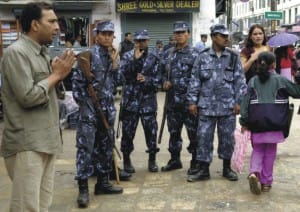
Nepal ends emergency, king retains extra power
India welcomes move, but seeks more steps
Reuters, PTI, Kathmandu
Nepal's King ended a state of emergency two days early, the Palace said yesterday, but the sudden midnight proclamation does not reduce extraordinary powers he seized in February's royal coup.Politicians said it was a positive move but advised caution and urged the King to hold talks with political parties. Constitutionally, the three-month state of emergency granting the military extra powers of search, arrest and curfew had to end or be formally extended by midnight on Sunday. King Gyanendra's announcement made no mention of him giving up most of the extra powers assumed when he sacked the government, suspended democracy and took control himself on February 1 in a bid to end a long-running Maoist rebellion. The King suspended civil liberties, arrested the ousted prime minister and gave sweeping powers to soldiers to fight the Maoist rebels, drawing international condemnation and failing to check the rebellion. The midnight announcement came hours after Gyanendra returned from his first foreign tour since February 1, aimed at shoring up international support, a visit during which he convinced India to resume military aid. He had reassured India and the United States, another major supporter, that he would restore democracy as soon as possible. Upon his arrival at Tribhuvan International Airport the King said that during talks with Heads of States and Heads of Governments, he explained to them that "Nepal had given priority to the fight against terrorism and the Nepalese people's aspiration for restoring peace", according to Radio Nepal. The King added that he was influenced by his meeting with Indian Prime Minister Manmohan Singh at the Asian-African Summit. "I have taken the views expressed by Mr Singh seriously", the King told reporters at the airport. Meanwhile, reacting cautiously to lifting of three-month emergency in Nepal, India yesterday described it as the "first step" towards the restoration of multi-party democracy which still required immediate release of political prisoners and other measures to be taken. "We, Prime Minister Manmohan Singh and myself, had conveyed to King Gyanendra that political processes should be restored, political prisoners should be released, emergency should be lifted and Indian channels should be allowed to be aired and processes should be started which culminate in multi-party elections," External Affairs Minister K Natwar Singh told reporters here while commenting on the developments in Nepal. "This is the first step," he said. External Affairs Ministry spokesman said India wanted to see release of all political leaders still in custody and the restoration of civil liberties which could open the way for reconciliation between the two constitutional forces.
|