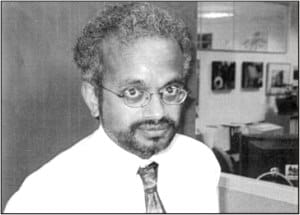
WB Economist Talks on HIV/AIDS Prevention
Needed an aggressive programme involving all
The Daily Star recently spoke to World Bank's chief economist Shantayanan Devarajan who is based in South Asia Region. During his hour long exchange at a city guest house with Inam Ahmed, News Editor and Naimul Haq, Senior Staff Correspondent of The Daily Star, he explained how crucial it is to invest more fund in prevention of HIV/AIDS activities and country's leadership role. He was in the Bangladesh capital for a short visit.The Daily Star (DS): Can you, sir, give us an overview of your assessment of the HIV/AIDS situation in Bangladesh. In fact, for a long time we have been hearing that Bangladesh could face a serious HIV outbreak. Shantayanan Devarajan (SD): To the extent we have any data which is very patchy and often hard to substantiate, for Bangladesh it looks like that the prevalence rate of HIV currently is fairly low which is less than one percent among the risk behaviour groups. I think it is no longer relevant just to look at current rate of HIV prevalence as much as what are the indicators that might lead one to be concerned that the epidemic may group up. Remember that all the African countries with HIV burden that today have roughly 25 percent prevalence rates had started out at 0.1 percent. In fact, I remember being there in South Africa when the HIV prevalence rate there was 0.1 percent. And there I do have some concerns about Bangladesh. Because I see that the way HIV/AIDS have exploded in southern Africa has mostly to do with denial and stigma. And I see both of those essentially already present in Bangladesh. Any experience we learnt from the African lessons is that the leadership of that country continues to go into denial. This was the case of South Africa. The President Thabo Mvuyelwa Mbeki first kept denying when he first said he never knew who died of AIDS, and secondly, he kept saying that there is no relation between HIV and AIDS. And when you have that kind of mindset in the leadership it makes it very difficult for the people to implement some kind of prevention programme. To the other side of HIV/AIDS is, it is very easy to prevent. Unlike other diseases if a disease is spread by human behaviour not like a mosquito that bites you and you cannot control. Here in the case of HIV transmission you take an action like unprotected sex. So that is one side. The other side is the stigma. The stigma is also believed to be widespread in Africa where whole groups who were the ones who needed most protection and most help to prevent the HIV virus from spreading were the ones who got stigmatised most. For instance, I see commercial sex workers (CSWs) and this is where my concern is about Bangladesh. Because there are say about one million rickshaw pullers and many of them stay away from their families who may buy sex. And there are some sporadic evidence that police here in Bangladesh pick the CSWs and one of the criteria they use to arrest them is if they (CSWs) carry any condom or not. Now if any of these groups are discouraged from using condom then we may have a serious problem in hand. And if that is the mindset as you said, apparently this could lead to an HIV/AIDS explosion. DS: What we are more interested in is the economic cost of HIV/AIDS. We have noticed like in Brazil that the government has involved multiple ministries to address HIV/AIDS problem and they don't just see it narrowly as merely as a health issue. Having said that do you think similar approach or strategies have been taken in South Asian countries? What should be the proper approach on this issue from World Bank's point of view? SD: Well, there are two parts of that question. The first one is that the economic cost, which we haven't talked about yet, of the disease could be so large that it actually requires the attention of entire government to try to address in a large scale with some specific aspects of HIV/AIDS. Because AIDS unlike other diseases afflicts young adults and when it afflicts young adults it has effect not just on them but also on their children. And their children are less able to go to schools and they often become orphans when their parents die. This means it could lead to a whole generations of orphans who are under-educated or less educated than their parents were and they in turn are less able to take care of their children. So their children would be even less educated so you can have a whole generations who are less educated. Remember education is the human capital it is the engine of long-term economic growth, with it you could actually have a big impact on the growth of the economy. In South Africa some simulation we did shows that if the economy otherwise was growing at three percent a year it could actually go the other way -- start declining down to a point where in about three generations in 80 years it could be about two thirds of the size where it started. That's huge, it's a major, major cost of AIDS in a country. Now, on the other side, its not something absorbing now. Even more important is that the economy could be growing reasonably well now but not far into the future and we could seriously be making mistake by ignoring. What you should do now is to act. Because, I believe Bangladesh has the opportunity to act now. This is the time to act. Because when it gets too big you cannot do it. You can not control it. In South Africa we have five million people infected with HIV virus. Even if you were to treat all of them at about one dollar per head it would cost you five billion dollar a year. DS: Can you give us a worst case scenario and what could be Bangladesh situation at that point? SD: Well, typically around one percent prevalence rate of the total population is considered epidemic for any population. Once the disease reaches above that one percent then it starts spreading into other population or in other words the general population. This means the HIV infection is no longer restricted among the risk behaviour group and the general population is at risk and this is the take off point for HIV as observed in other countries. The consequences is huge, of course, on the health sector. Coming back to the multi-sector approach -- what this means is that if we want to act early we don't just act on the health sector, we need to come out of this narrow focus, for instance, on the education sector. Because as I said earlier, orphans do not get enough skills so educating them could be a good investment in terms of developing human resources. Then we also need to focus and act on the young adults because they are the most vulnerable group in the population. And so we need to talk to them about safe sex, the education on this issue is very vital or we could leave the battle right there. You need leadership from the very top, the head of state to come out like in Uganda leaders talk about HIV/AIDS in almost every single speech they deliver. In fact, Uganda is one of the success stories where they have managed to reverse the epidemic. And in India the Prime Minister Manmohan Singh has taken over the leadership becoming the chairman of the National AIDS Committee in India. Even the finance ministers need to turn their focus on HIV/AIDS issues to understand how important it is to invest in prevention activities and if we don't spend money now we could end up with economy shrinking. DS: What has the role of the World Bank recently in combating the HIV/AIDS epidemic globally? SD: We developed a facility in Africa called MAP, which stands for Multi Sector Aids Programme. It is basically a programme where a country has to come up with a feasible AIDS programme and if we in the Bank think it is feasible then we just give them the money. The other role we are now playing is to get the leadership in the countries to get as much attention as possible -- its rather an advocacy job we are now focusing on because we believe leadership is very crucial in addressing the problem and to stop the epidemic where it is now. DS: Do you not think for country like Bangladesh having such a small number of people living with HIV (PLWHA) to focus more on the treatment than prevention? SD: Normally there is this debate over prevention and treatment. And its true prevention is more cost effective than treatment. On the other hand, Bangladesh has an opportunity here because the number of cases is so small that you can actually treat all of them and have hundred percent treatment for them all now. At the same time have an aggressive prevention programme that would involve all spheres of the society -- the women's group, children's group, youth's group and so on. In fact, you have an advantage, this is a country of NGOs who can drive the issues to the grassroots while the government acts as a policy maker and a catalyst. DS: Thank you very much, sir, for your time. SD: Thank you as well.
|