Musings
Nasreen and her world of Tagore songs
Kavita Charanji
Music is my therapy," says Nasreen. "Rabindra Sangeet is spiritual. When I am sad, it lifts me up," she adds. Though she has had a gap of four years as a performer on radio, stage and TV--due to personal reasons--she is veering around to the view that it may be a good idea for her to plunge herself in work. And that means putting her soul into her singing persona and her role as Associate Professor in the physics department of Dhaka University.At the moment she has taken a few tentative steps to get back to singing again. Probhat Chandra Dhar, a tabla player, visits her home once a week and she practices singing with him. She will go back to regular practice this month. "For the time being I will sing at home and then decide whether to go back to public performances or not," says Nasreen. "I have to go back to singing otherwise I might not be able to hold on to life," she adds. For the moment she has a modest goal: to sing at functions held by the Physics Department of Dhaka University. Her brother Iqbal Bahar Chowdhury, head of Bangla service, Voice of America (VOA), pitches in the conversation by gently reminding her of dates. According to him, Nasreen lacks the ambitious streak and is "lazy'. The only CD, which she has to her credit, he says, is Shudhu Tomar Bani, a family CD of recitation and songs. The performers are Nasreen along with her three siblings. Nasreen is on firm ground in terms of technique. A student of the Bulbul Academy of Fine Arts (BAFA), she has a diploma in Rabindra Sangeet from this institution. She was, in fact, in the first batch to get the certificate in 1961. Apart from BAFA, she was also involved in an organisation called Oikotan, which sought to promote Rabindra Sangeet. This group used to organise cultural shows in Dhaka. Nasreen recalls singing Tagore, Atul Prasad and DL Roy songs. Starting out singing on the radio and TV in 1964, she has had a successful career in Rabindra Sangeet. What draws her to this genre of music? Nasreen warms up to the subject. As she says, "I am attracted by the lyrics and tune of Rabindra Sangeet --particularly the devotional and seasonal songs. It touches my heart in a way that modern music doesn't. When you sing a song on the rainy season, you can feel the rain. For example, in Hridya Mondrilo, you can feel the thunder and raindrops. Then there's Shokatore Oi Katiche, a sad song, which lifts me up when I am down. " Nasreen believes that Rabindra Sangeet is evergreen. Who can forget Tagore's songs which have been rendered into the national anthems of India and Bangladesh, she asks. How does she view fusion music? She is quite open to it. "I quite enjoy Baul songs with western musical instruments. But I don't like this idea with Rabindra Sangeet. I don't mind a few adaptations but not much," she maintains. For now Nasreen has set herself a modest goal. "I want to sing for myself and my satisfaction," she says. Here's hoping that the vicissitudes of fate will not prevent her from attaining this ambition.
|
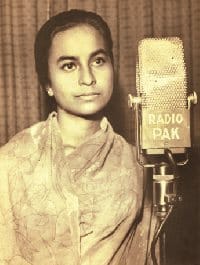
Nasreen Shams presenting Tagore songs from the studio of Radio Pakistan, Dhaka in the mid 1960's |

