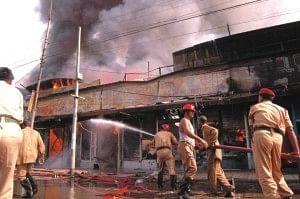
Fire department sounds alarm
Unplanned city living on the edge
Kausar Islam Ayon
The Fire Service and Civil Defence Department has warned that in the event of an earthquake or a large-scale fire, the city would experience massive loss of lives and properties as they are still incapable of handling such calamities. The fire department is already failing to provide necessary service in the city due to inadequate fire fighting preparations, manpower, unplanned and narrow roads and especially scarcity of water, said officials. "The city has been built in an unplanned way, which has made it fire-prone. And with the growth of the city, facilities for security and precautionary measures have not been increased or updated," said one fire service official. With the industrial growth, the possibilities of chemical fire have also increased but the department does not have equipment to fight such fires. "We do not have any chemical tender (a fire-fighting device loaded with dry powder, carbon-dioxide gas, foam etc designed to fight chemical fire). Already two or three such fires have taken place in the city but those were not that devastating. However, serious accidents could take place at any time and we will be helpless when they happen," said the official. The fire service department has often been blamed for failing to perform its job properly by the victims. But officials defended their position saying that fire fighting has become a very difficult task in the city due to lack of necessary infrastructure. There are only fourteen fire stations in the city, which is not enough to provide service in 1530 km of metropolitan area. Sources said that except Sadarghat, Tejgaon, Postogola and Mirpur, other stations are running with only two vehicles equipped with fire fighting devices whereas there should be at least three in each station. "Besides the number of firemen is also insufficient for a city of 13 million residents. There is only one fire fighter for every 30 thousand people," one official said. In most cases, the department is criticised for late arrival at the spot. But fire fighters attribute this to poor access, narrow roads, traffic jam and water crisis. "We will be able to reach the scene quickly if the traffic department listens to our repeated requests and clear the jams. Disappearance of water basins, natural ponds and low-lying areas also hamper rapid fire fighting. "It is still possible to provide better service even with this limited manpower if there is enough supply of water. But you cannot depend on the supply from WASA. It cannot even ensure enough drinking water let alone the huge amount necessary for fire fighting. "Our water tanks become empty within ten minutes while it take almost an hour to refill it," the official said. The department is equipped to fight fire at a height of six to eight floors but it does not have the capacity to deal with high-rises which have mushroomed over the last decade. "There will be total chaos if these high-rise structures catch fire. Most of these buildings are at grave risk as they have little or no fire fighting mechanism of their own," he warned. Many Dhaka high-rises have not yet installed fire-fighting equipment, which is mandatory according to the Fire Protection Act 2003. Another allegation against the fire service department is that it does little to create awareness among the general public about the danger of fire and how to prevent or fight it. The officials admitted that it was partly true but believed that effective steps should be take by both by government and private organisations in creating awareness. "People should remember the emergency numbers. They can easily contact the fire service by dialling 199 from any phone with T&T access," said Selim Newaj Bhuiyan, assistant director of fire service and civil defence, Dhaka.
|