Impact of HIV/AIDS
Suneeta Mukherjee
HIV/AIDS is classified as the deadliest epidemic of our time. Over 22 million people have lost their lives and almost double are currently living with HIV/AIDS. All attempts to develop a vaccine seem to slip from our hands as the virus is one that is constantly mutating and evading human intelligence. While the hardest hit is Africa, this pandemic has now taken hold of many countries in Asia: and an estimated one million in China, four million in India and six million in Africa are living with HIV/AIDS. The epidemic is not only killing people but also imposing heavy burden on families, communities and economy. Impact on economy and life expectancy
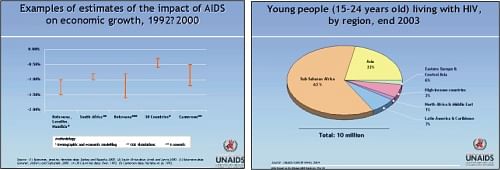
The experience of sub-Saharan Africa has confirmed that HIV/AIDS can easily devastate an economy. Economies of developing countries are often labor intensive and it is the prime age population that are infected by HIV/AIDS. The direct and indirect cost incurred by the loss of productivity, due to increased HIV/AIDS-related morbidity and mortality, is enormous. A rapid deterioration of health conditions in these countries strains health expenditure, both in private and public sectors, and ultimately causes havoc to the national budget. The antiretroviral drugs do offer a respite and prolong life only but these drugs are expensive and can be made available to less than 10 per cent of the infected population. In some cases the macroeconomic impact of the epidemic outburst has been as severe as turning the growth rates to negative (e.g. in Zambia). Thus economic gains that took years to achieve, erode within short periods. The life expectancy in the seven highest prevalent countries in Southern Africa is lost by 30 years. The graph above shows the sharp decline in life expectancy in some of the severely affected countries .In worst affected countries like Botswana where the prevalence rate of HIV/AIDS has reached 40 per cent, the life expectancy has dropped to 37 years from 67 years. In addition to demographic, health and economic impact it also affects other sectors adversely. For example, HIV/AIDS is threatening recent gains in basic education and disproportionately affecting girl's primary school enrolments. Though going to school is productive, girls' are the first to be pulled out of school to care for sick relatives or to look after young siblings. HIV: Poverty and feminisation
A billion people live on the edge of survival and half the world lives on less than two dollars a day. Poverty exposes women to the risk of chronic ill health that come with malnutrition and neglect. Women particularly in developing countries face illiteracy and ignorance and lack of awareness and information about HIV/AIDS. They cannot negotiate condom use or refuse sex with their partner. An increasing number of women and girls are driven into sex trade due to poverty, gender inequity and inequality increasing the vulnerability of women to HIV/AIDS. In addition women throughout our sub-continent are subject to sexual violence within the family and outside. Out of 14000 new infections occurring every day, 12000 are in aged 15-49 years, of whom almost 50 per cent are women and 50 per cent are 15-24 year olds. The HIV/AIDS crisis has greatly increased the responsibilities of women and girls both within the home and in the wider community. Globally, every minute 10 new infections occur, 14,000 men, women and children are infected daily. AIDS killed three million people last year alone, 95 per cent of them in developing countries, thereby demonstrating the close linkages between HIV/AIDS and poverty. In South and South- East Asia more than a quarter of adults and 40 per cent of young people living with HIV/AIDS are women. The feminization of the disease widens inequality and poverty. Female condoms are, an instrument of women's empowerment and this should be readily accepted as a supplement to the male condom to prevent infection. In Bangladesh some studies have been done on female condom and some are being undertaken now. The registration by the government needs to be expedited and clients motivated to use them when ever needed. Vulnerability of the youth
The impact of HIV/AIDS on young women and girls aged 15-24 specially those who have recently become sexually active is more dramatic. They are two and half times more likely to be infected than male in the same age group. Studies have shown that some of adolescents had their first sexual encounters with commercial sex workers just for their inherent tendency to experiment. What can be done
Experience has shown that although a cure remains elusive, the natural course of the epidemic can be changed with the right combination of leadership and comprehensive action. Clear-cut national leadership, widespread public awareness and intensive prevention efforts have enabled nations to reduce HIV transmission. In Asia, Thailand has averted about five million HIV infections during 1990s, by involvement of their national leadership and religious and cultural institutions. The Greater involvement of people living with HIV/AIDS (GIPA) has become a global force to change the social response to the epidemic. Basically young people need better skills to have safer sex. The gap between perceived behavior and actual behavior also need to be bridged. Lack of information, education and services place young people at the center of HIV vulnerability. In fact research has shown that giving information does not increase promiscuity but helps the youth to take responsible decisions and handle sexual issues better. Research has suggested that media campaigns are most effective when combined with local education efforts. In South Africa a survey found that innovative media approaches have been helpful in breaking down social taboos, regarding adolescent sexuality, promoting responsible sexual behavior and increasing use of comprehensive health services. "100 per cent condom use" policy in brothels and partner reduction have a substantial effect on slowing HIV transmission. Sexual behavior itself changes the sero incidence of HIV. Studies in Africa has shown that the effect of HIV prevention intervention, particularly partner reduction appears to have had a similar impact as a potential medical vaccine of 80 percent efficacy, which is known as "Social vaccine" in Africa. We have to all work together to prevent this epidemic in Bangladesh. Suneeta Mukherjee in UNFPA Representative in Bangladesh.
|