America votes
AKM Mazharul Islam
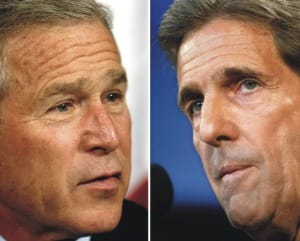
Let's take a closer look at the two candidates running for president this year:George W Bush: The Republican
George Walker Bush was born on July 6, 1946, in New Haven, Connecticut, the first child of future president George H. W. Bush. In 1948, the family moved to Odessa, Texas, where the senior Bush went to work in the oil business. George W. grew up mainly in Midland, Texas, and Houston, and later attended two of his father's alma maters, Phillips Academy in Andover, Massachusetts, and Yale. After graduating from Yale with a history degree in 1968, Bush joined the Texas Air National Guard, where he served as a part-time fighter pilot until 1973. After receiving an MBA from Harvard Business School in 1975, he returned to Texas, where he established his own oil and gas business. In 1977 he met and married Laura Welch, a librarian. The couple has twin daughters, Jenna and Barbara, born in 1981. They also have two dogs (Spotty and Barney), a cat (India), and an armadillo (Wetback). Coming from a political family -- his grandfather Prescott Bush had been a senator from Connecticut -- George W. had been interested in politics since childhood. In 1977, he entered the fray himself, unsuccessfully running for US Congress from the West Texas district that included his hometown of Midland. Following his defeat, Bush returned to the oil business. Bush then headed to Washington to become a paid adviser to his father's successful 1988 presidential campaign. After the election, Bush returned to Texas and headed up a group of investors to buy the Texas Rangers baseball team. Bush again entered politics in 1993, running for the Texas governorship. Although he had a tough opponent in the immensely popular incumbent Ann Richards, he created a clear agenda focused on issues such as education and juvenile justice and won with 53 percent of the vote. He was reelected in 1998, not long before he announced plans to run for president. During the 2000 campaign, Bush characterized himself as a "compassionate conservative," a somewhat vague description meant to evoke a kinder, gentler Republican. On the core issues, Bush adhered closely to the traditional conservative line, favouring small government, tax cuts, a strong military, and opposing gun control and abortion. His choice of running mate, Dick Cheney, former secretary of defense during his father's administration, provided his campaign with seasoned Washington political experience. The 2000 election between George W. Bush and Vice President Al Gore was one of the closest in the country's history. By early evening on election night, it was apparent that whoever won Florida would win the election. Bush's razor thin margin of about 1,200 votes prompted an automatic recount. The case ultimately ended up in the US Supreme Court. Bush officially became the president-elect on December 13, after the Supreme Court reversed a decision by the Florida Supreme Court to allow manual recounts of ballots in some Florida counties. With Florida in his column, Bush won the presidency with 271 electoral votes, just one more than he needed, although he lost the popular vote by half a million. The Supreme Court decision generated enormous controversy, with critics asserting that the Supreme Court, and not the electorate, had effectively determined the outcome of the presidential election. John F. Kerry: The Democrat
John Kerry was born on December 11, 1943 at Fitzsimmons Military Hospital in Denver, Colorado, where his father, Richard, who had volunteered to fly DC-3s in the Army Air Corps in World War II, was recovering from a bout with tuberculosis. Not long after Senator Kerry's birth, his family returned home to Massachusetts. A graduate of Yale University, John Kerry entered the Navy after graduation, becoming a Swift Boat officer, serving on a gunboat in the Mekong Delta in Vietnam. He received a Silver Star, Bronze Star, and three Purple Hearts for his service in combat. By the time Senator Kerry returned home from Vietnam, he felt compelled to question decisions he believed were being made to protect those in positions of authority in Washington at the expense of the soldiers carrying on the fighting in Vietnam. Kerry was a co-founder of the Vietnam Veterans of America and became a spokesperson for the Vietnam Veterans Against the War. In April, 1971, in testifying before the Senate Foreign Relations Committee, he asked the question of his fellow citizens: "How do you ask a man to be the last man to die for a mistake?" Kerry then went to law school at Boston College before becoming a top prosecutor. Kerry took on organised crime and put the number two mob boss in New England behind bars. He modernised the Middlesex County District Attorney's office, creating an innovative rape crisis crime unit, and as a lawyer in private practice he worked long and hard to prove the innocence of a man wrongly given a life sentence for a murder he did not commit. In 1984, after winning election as Lieutenant Governor in 1982, Kerry ran and was elected to serve in the United States Senate, running and winning a successful PAC-free Senate race and defeating a Republican opponent buoyed by Ronald Reagan's reelection coattails. Senator Kerry was re-elected in 1990, and again in 1996, defeating the popular Republican Governor William Weld in the most closely watched Senate race in the country. He is now serving his fourth term. John Kerry entered the Senate with a reputation as a man of conviction. He confirmed that reputation by taking bold decisions on important issues. He helped provide health insurance for millions of low-income children. He has fought to improve public education, protect our natural environment, and strengthen our economy. He has been praised as one of the leading environmentalists in the Senate, who stopped the Bush-Cheney plan to drill in the Arctic National Wildlife Refuge. As chairman of the Senate Select Committee on POW/MIA Affairs, he worked closely with John McCain to learn the truth about American soldiers missing in Vietnam and to normalize relations with that country. As the ranking Democrat on the East Asian and Pacific Affairs Subcommittee, he is a leading expert on that region, including North Korea. Years before September 11th, John Kerry wrote The New War, an in-depth study of America's national security in the 21st century. He worked on a bipartisan basis to craft the American response to September 11, and has been a leading voice on American policy in Iraq and Afghanistan, the war on terrorism, the Middle East peace process, and Israel's security. John Kerry is married to Teresa Heinz Kerry, and they have a big joint family that includes two daughters, three sons, one grandchild, and a German shepherd named Cym. AKM Mazharul Islam writes from the Department of Anthropology, Minnesota State University, USA.
|
|

