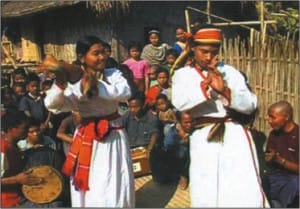
An insight into the lives of the Tipras
Afsar Ahmed
Bandarban, where the mountain waves create a magical veil with the tropical growth, is the land of the Tipras the indigenous ethnic group of Bangladesh. They are the third largest such group living in the hilly regions of Bangladesh. A gripping documentary on the lifestyle of these indigenous people, titled Tipra life at Hatibhanga, has been screened recently at the Spectra Convention Centre. This was yet another successful venture of A Masud Chowdhury, the director and cinematographer of this documentary after the screening of his Bandarban's Bomang. The script and research was done by Shumon Shikdar while Mohiuddin Tipu did the editing. The word Tipra is derived from the word Toipra. Toi means water and Pra means inhabitants. Previously they lived in the water surrounded Tripura Kingdom and that's why they were called Toipra. But now they live on the high hills in a house called machaang. In their language it is called nokkochuk. Most of them speak their native language Kokporokh, the literal meaning of which is the 'human language' that only has the spoken form with no written script. The documentary started with the footage of Hatibhanga Para, a place in the heart of Bandarban. There is a saying that when the Tipras first came here and built their colony, a group of wild elephants destroyed it all and thus the name of the place is called Hatibhanga. By nature Tipras are nomadic and don't like to stick to one place. On the contrary, these people move their entire village according to their needs. Apart from the hill tracts, this ethnic people are also scattered in other parts of Sylhet, Moulovibazar, Comilla and Shitakunda. The nature dependent Tipra's main source of income is Jhum cultivation, growing paddy, potato, cotton, mustard and turmeric among others. The patriarchal system of Tipra society is not an obstacle for the women. Rather they are hardworking and are involved in household and outdoor works as well. One scene of the film featured two Tipra women, baskets on their back and machetes in hand, trailing on hills to find their favourite vegetable Tha the roots of arum. The Tipra women make their clothes in the traditional Komor Tant which they called Ronai (a movable loom attached to the weaver's hip). The tops made out of this loom are called Risa while the lower part is called Hurinai. The Tipra women are ethereally beautiful. Fom their head to feet they love to wear traditional jewelry. They love to wear a good number of beads and their necklaces weigh almost 3kgs. They wear silver bangles called kuchikharu . Surjamoni and Shoila Tripura are famous Nukhai or basket makers. By using thin bamboo strips and coloured cane, they have created magnificent colorful baskets which have a great market value too. Likewise, the women make flower brooms very well. The hardworking Tipras never miss the slightest opportunity to enjoy themselves. Botol Nrittya the bottle dance is their most famous tradition and this dance is held during the marriage ceremony. Its not the simple dance, rather a secret competition between the dancers, who go on to balance the bottle on their heads. The winner is the woman who can balance the bottle on her head, even carrying plates in hands and standing on vessels. Garaya is another dance performance on to celebrate New Year or to depict the tale of young lovers. The Tipras are easily recognisable by their facial features. As time goes by, they have become a part of our vast cultural heritage. And the recent documentary authentically depicts the true life of this ethnic group in the hills of Bandarban.
|