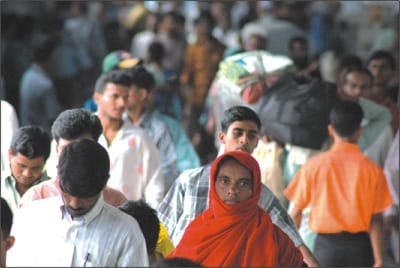
Displaced streaming into city
At railway and bus stations and launch-terminals, numerous new faces can be seen every day, as they were forced out of their villages by the devastating floods
Mizanur Khan
Ayesha Begum, 36, who abandoned her submerged home in Sirajganj, managed a tiny room at a flood shelter in Bashabo. She, along with her husband and their 8-year-old daughter Aklima, came to Dhaka a week ago and spent two nights at Kamalapur Railway Station."We have nowhere to go. We have finally come here after roaming many places and spent two nights without food or water," Ayesha said. Desperate for a job, her farm worker husband Abul Kashem, 46, was out of the shelter and Ayesha does not know when he will be back. "He will grow mad if he does not find some food today. How can a child spend days without food," she asked. "If we stay in Dhaka, we will be able to find some baby food but there is nothing back at home." Ayesha's is not a one-off story. Displaced people moved into the city because of the raging floodwaters that blighted two-thirds of Bangladesh. Because of the floods, Dhaka has to provide shelters for new comers while the city is already overburdened with more than 13 million people. "Poor people have been coming to the city in search of jobs for long. Now the numbers will increase as they are driven by the deluge," a university student said. The floodwaters left more than 30 million people homeless or cut off in 47 districts, while about five million people are affected in the capital. At railway and bus stations and launch-terminals, numerous new faces can be seen every day, as they were forced out of their villages by the devastating situation. Abdus Salam, 35, who took refuge at Kamalapur Railway Station said: "I have rushed to the capital to survive. Floodwaters have washed away my home and crops. I do not know whether I could go back." Many flood victims in different shelters and slums said they would not go back to their home villages soon. Slum dwellers have moved to higher ground and city pavements as shanties have been inundated. Most of them have come from the outskirts of the city as their homes in the low-lying areas went under water. More than 200,000 people have taken shelter in schools that turned into flood shelters in Old Dhaka, Kamrangirchar, Badda, Kamalapur, Demra and Keraniganj. The inflow of displaced people to the city is up. They are rushing to the capital like floodwaters. Most are living under flimsy shelters built with plastic sheeting on sidewalks and pavements. Subed Ali, a farmer from Kishoreganj, has bought a boat at Tk 1,500 to make a living. "City streets have turned into canals. If I pedal a rickshaw, it will not help me," he said. "I am happy with my earnings. I ferry people from Bashabo to Kamrangirchar and charge a passenger Tk 40." "I will not go back even after the recession of water from the city. When floodwaters go down I will sell this boat and buy a rickshaw," he added while rowing his boat through the dark and filthy water through the narrow streets in Bashabo. The agriculture ministry assessed the agricultural loss in 38 flood-hit districts and it stood at Tk 22.91 million until July 25. The ministry decided to provide 1.2 million affected farmers with seeds, saplings, fertiliser and pesticides.
|