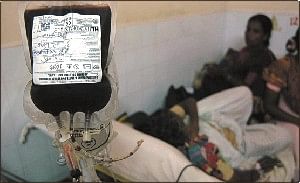
Illegal blood banks mushrooming
Mizanur Khan
Over 100 blood banks are operating in the city without permission of the government at risk to public health, as the health directorate apparently shut its eyes to the mushrooming business."Private blood banks are growing around hospitals and clinics and government control over blood sales came to nought," said a health directorate official, who would not give his name. Sources alleged dishonest businesspeople, most of them retired doctors of blood collection centres in government hospitals, run the illegal blood banks in underhand dealings with high officials of the directorate. People in times of emergency rush to the blood banks, which sell substandard blood. As government hospitals lack effective collection units, patients rely on the private centres that usually collect blood from professional donors. "About 70 percent of the patients at the emergency departments of hospitals are given unsafe blood from professional donors," a doctor at Dhaka Medical College Hospital (DMCH) said. A conservative study says voluntary donors provide about 50,000 bags against an annual demand for 250,000 in the city, with the rest coming from people who sell two or three bags of blood a month to scrape a living. Sandhani, a medical students' organisation that organises blood donation camps, collected 40,000 bags last year. Other non-profit organisations such as Bangladesh Red Crescent Society, Lions Club and Rotary International collected 20,000 bags the same year. "Most professional donors are drug addicts and their blood contains inadequate blood cells and harmful virus like hepatitis B," said Dr Ziaul Islam Khandokar, organiser of a voluntary blood donation programme under Quantum Foundation. He says his organisation collects and supplies blood after five tests such as HIV, HBsAg, (hepatitis B virus), HCV (hepatitis C virus) and VDRL (test for syphilis) and malaria. Sandhani, Red Crescent, Lions International and Quantum Foundation collect blood from voluntary donors and supply it to the patients. "We take Tk 100 a bag and Tk 350 in service charge," Dr Khandokar said. Private blood banks do not have screening facility and their owners say they usually do not carry out screening. They said screening costs about Tk 450 a bag, while they give professional donors only Tk 90 a bag. "If anyone goes for all tests, the price of a blood bag will cross Tk 700 up from the current price Tk 200," said Mohammad Sharif, owner of Mukti Blood Centre on Green Road. The DMCH blood centre has insufficient collection from voluntary donors. "The DMCH needs about 100 bags a day, but the blood centre can provide only 40 bags," said Medical Technologist KG Mortuza. "Most bags delivered through the blood bank come from Sandhani or the relatives of patients. Collection at government blood banks is poor," he said. In emergency, brokers take advantage of the situation and lead the relatives of patients to private blood banks, which sell blood at higher prices and charge high for blood grouping and cross matching. "It was late night and I could not manage blood for my husband. I rushed to a private bank in Lalbagh and bought two bags of blood at Tk 1,200," said Rezina Khatun, attending to her husband at the DMCH. Private blood banks in Lalbagh and Chankharpul, close to the DMCH, buy a bag of 450ml blood at Tk 90 and sell it at Tk 350. "A, B and O negative blood is costlier than positive groups. It becomes dearer at midnight," said Mohammad Babul, an office assistant of Donor Life Save Blood in Chankharpul. Director of Hospital at Health Directorate Dr Abdur Rashid says there is no registered private blood bank in the city, as the organisation does not license such business. "We are working on a policy for blood banks and hope to submit its draft to the health ministry by next month," Dr Rashid said. He said a few unauthorised blood banks near the DMCH, Suhrawardy Hospital, Institute of Diseases of the Chest and Hospital in Mohakhlai sell blood illegally. "We have formed a team to look into the illegal business. We will take action after receiving the report."
|