The Strength Within
Going green in Barind
Ashfaq Wares Khan
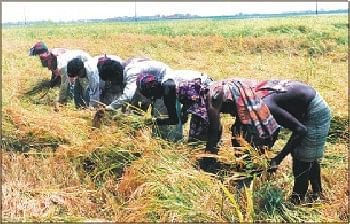
Rafiqul Islam has seen a change over the last 14 years of his life in terms of celebrations: from one harvest with one celebration to three harvests with as many celebrations.Rafiq is a farmer from Arishpur village in Godaigari upazila in the western part of Rajshahi, known as the Barind area, where the naturally dry landscape has been dabbled with the greens in 18 years with the help of a seemingly innocuous device: a deep tubewell. Over the past century, Barind farmers have become used to its dry and desolate landscape that is only suitable for cultivating crops during the monsoon for the absence of one crucial yet unavoidable element: water. "We had to collect water from the puddles at the bottom of ponds. It may have been dirty but that was all we had in most seasons," said Rafiq, eyes watery from recalling the pain brought about by the scarcity of water. In his early age, Rafiq learned from his father the hard way of ploughing Barind land in the west of Rajshahi. Evident from the lack of greenery in the vast area starting from the Rajshahi's west to Chapainawabganj, the scarcity of water has prevented farmers from fully occupying themselves with one profession. Rafiq like thousands around him used to sell his crops in advance to feed his familiy during the near-famine in the dry season and migrate to other districts looking for work. As a migrant worker, Rafiq spent a winter digging canals in Panchagarh, worked as a construction-worker in Rangpur and pulled rickshaws in Dhaka besides the innumerable days he spent as a day-labourer in other cities. "I did not think myself as a farmer any more. I was not sure what profession I would have to take the next day to feed my wife and four children," Rafiq recalls. The barren land meant that the area was squalid with the imprints of poverty that can still be seen in Barind where a famine-like situation still drives the farmers away and the green of nature has not touched the dry land as yet. Things have changed when a government official, Asaduzzaman, from Bangladesh Agriculture Development Corportation challenged foreign experts who said that no water can be extracted from beneath the surface in the area. He sank a tubewell 250 feet underground, to begin with. After the initial success, Asaduzzaman went on to install deep tubewells in the dry fields in 1986, which by now has given the lifeline to farmers in all 49 Baring upazilas, including Rafiq's. In what came to be known as the Barind Multipurpose Development Project, one of the rare self-sufficient and efficient wings under the agriculture ministry, arable land has expanded from a paltry 129,000 acres to 531,000 acres in 18 years. The project has now as many as 6,274 deep tubewells. For Rafiq, the success of deep tubewells in his fields assured him of a new future. "This is my family's land and I am a farmer, so my choice has always been to plough these fields. Now I can pass this piece of 2.5 bighas to my son and be assured he will be successful." These days, Rafiq sells 20 maund of rice for each of the three varieties that he grows from three seasons, alongside the Amon of monsoon. He also cultivates Iri and Tiamon. An economic success came with the greening lands and the vast empty areas are being re-populated with a huge influx of people coming in from neighbouring districts. Like his fellow farmers from nearby fields, Rafiq regularly consults with the Barind project officials to ensure efficiency by regulating the price paid for water and providing feedback on weather-land conditions and services. The community of farmers has taken up the transition from desolation to happiness. They have moved from towns to fields, concentrating on their crops.
|